
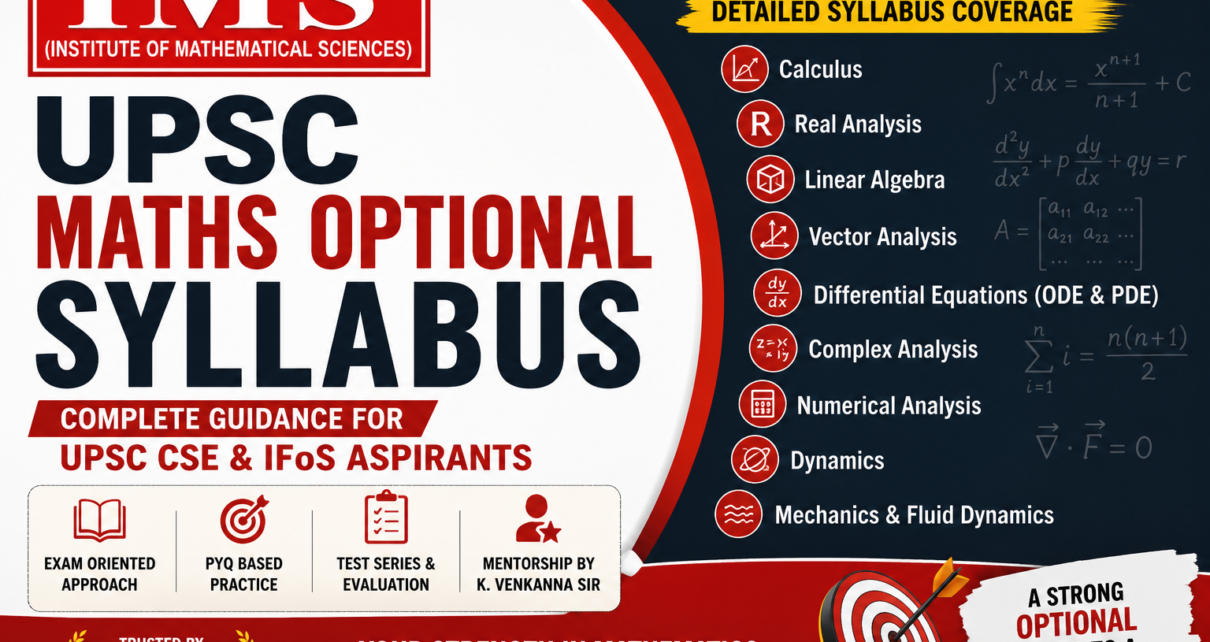
The UPSC Maths Optional syllabus has two papers of 250 marks each, totaling 500 marks. Paper I covers Linear Algebra, Calculus, Analytic Geometry, ODEs, Dynamics, Statics and Vector Analysis. Paper II covers Algebra, Real Analysis, Complex Analysis, Linear Programming, PDEs, Numerical Analysis and Mechanics.
Quick Overview
| Detail | Information |
|---|---|
| Total Marks | 500 (250 + 250) |
| Number of Papers | 2 |
| Nature | Optional subject, UPSC Civil Services Mains |
| Also Valid For | Indian Forest Service (IFS) exam |
| Ideal For | Engineering / B.Sc. Maths background candidates |
| Scoring Style | Objective, proof-based, high-accuracy scoring |
UPSC Maths Optional Syllabus: Paper I (250 Marks)
| Topic | Key Areas Covered |
|---|---|
| Linear Algebra | Vector spaces, linear transformations, matrices, rank, eigenvalues, Cayley-Hamilton theorem |
| Calculus | Limits, continuity, differentiability, mean value theorems, maxima-minima, multiple integrals |
| Analytic Geometry | 3D coordinates, planes, lines, spheres, cones, cylinders, conicoids |
| Ordinary Differential Equations | First and higher order equations, Laplace transforms, applications to mechanics |
| Dynamics & Statics | Rectilinear motion, projectiles, work-energy, equilibrium of forces, virtual work |
| Vector Analysis | Vector algebra, differentiation, integration, Gauss/Stokes/Green’s theorems |
Paper I builds the mathematical base. Every later topic in Paper II assumes fluency here, so aspirants are advised not to rush through it.
UPSC Maths Optional Syllabus: Paper II (250 Marks)
| Topic | Key Areas Covered |
|---|---|
| Algebra | Groups, rings, fields, homomorphisms, Sylow’s theorems |
| Real Analysis | Sequences, series, Riemann integration, uniform convergence |
| Complex Analysis | Analytic functions, Cauchy’s theorem, residues, conformal mapping |
| Linear Programming | Convex sets, simplex method, transportation and assignment problems |
| Partial Differential Equations | First and second order PDEs, boundary value problems |
| Numerical Analysis & Computer Programming | Numerical methods, algorithms, basic programming logic |
| Mechanics & Fluid Dynamics | Generalized coordinates, Lagrange’s equations, fluid motion equations |
Paper II is more abstract and application-heavy, which is why most aspirants attempt it only after Paper I fundamentals are solid.
Maths Optional and Indian Forest Service Qualification
Mathematics also qualifies as an optional for the Indian Forest Service (IFS) exam. A few practical points for aspirants targeting both CSE and IFS:
- The IFS optional syllabus closely mirrors the CSE Maths Optional syllabus, so one preparation cycle covers both
- IFS candidates appear for the same Preliminary Exam (including CSAT) as CSE candidates
- Choosing Maths Optional lets a candidate avoid preparing two separate optional subjects for two separate exams
This overlap is a major reason engineering-background aspirants often prepare for CSE and IFS together rather than treating them as separate efforts.
Maths Optional vs CSAT: Not the Same Thing
A common doubt among aspirants: does strong Maths Optional preparation cover CSAT automatically? No — the two test different skills entirely.
| Aspect | Maths Optional | CSAT (GS Paper II) |
|---|---|---|
| Stage | Mains | Prelims |
| Nature | Scoring paper | Qualifying only (33% needed) |
| Difficulty Level | Graduate/postgraduate level | Class X level numeracy |
| Focus | Proofs, derivations, advanced problem-solving | Comprehension, reasoning, basic numeracy, decision-making |
| Preparation Overlap | Minimal | Minimal |
Both need dedicated, separate practice. Treating CSAT prep as a byproduct of Maths Optional prep is one of the most common planning mistakes aspirants make.
Suggested Preparation Roadmap
- Months 1–3: Build fundamentals topic-by-topic across both papers, starting with Linear Algebra and Calculus
- Months 4–6: Move to previous year questions, sorted by topic rather than by year, to identify recurring question patterns
- Months 7–8: Weekly timed answer-writing practice, one full-length paper at a time
- Final 6–8 weeks: Revision of standard theorems, proofs, and formula sheets, plus mock tests under exam conditions
FAQs
What is the UPSC Maths Optional syllabus?
It covers Paper I (Linear Algebra, Calculus, Analytic Geometry, ODEs, Dynamics, Statics, Vector Analysis) and Paper II (Algebra, Real Analysis, Complex Analysis, Linear Programming, PDEs, Numerical Analysis, Mechanics), 250 marks each.
Is Maths a good optional choice for UPSC?
Yes, for candidates with strong quantitative aptitude. It offers fixed, objective evaluation and consistent scoring, but demands daily problem-solving practice rather than reading-based revision.
Can the same Maths preparation be used for IFS?
Yes. Indian Forest Service accepts Mathematics as an optional, and its syllabus overlaps closely with the CSE Maths Optional syllabus.
Does CSAT syllabus overlap with Maths Optional preparation?
No. CSAT tests basic numeracy and reasoning at a qualifying level, while Maths Optional tests advanced, proof-based mathematics for scoring in the mains.
How much time is needed to prepare Maths Optional?
Most aspirants take 8–10 months for a first attempt, covering both papers, PYQ practice, and multiple rounds of answer-writing and revision.
Why Aspirants Choose IMS4Maths for This Optional
IMS4Maths (Institute of Mathematical Sciences), led by K. Venkanna Sir at Old Rajinder Nagar, Delhi, has helped 5000+ students get selected into the Civil Services, including IAS, IFoS, and PCS. Recent results reflect this track record:
- Aanchal Sharma — AIR 05, IFoS 2025
- Monika Sharma — AIR 45, IFoS 2025
- Kailash Chand Yadav — AIR 93, IFoS 2025
- Ganji Srikanth — AIR 115, IFoS 2025
- Prateek Jain — AIR 3, IFoS 2016, scored 409 marks in Maths Optional
IMS4Maths offers both offline and live online classroom programs, structured PYQ-based test series, weekly answer-writing evaluation, and doubt-clearing sessions for CSE and IFoS Maths Optional aspirants. A new regular batch starts 23rd July 2026.
Start Your UPSC Maths Optional Preparation
Check the complete syllabus breakdown at IMS4Maths.