
Ever had a rig die on you right in the thick of a massive job? Yeah. It’s a total nightmare.
While hydraulic cylinders act as the heavy-lifting muscle of your machinery, we almost never give a second thought to the shiny piston rod actually doing the grunt work. But here’s the kicker: that impossibly thin, mirror-like layer of chrome? It’s often the only thing standing between a purring engine and a catastrophic blowout. If your gear is looking worse for wear, pinning down the exact right replacement chrome base isn’t just a maintenance task. It’s the whole ballgame.
The Backbone of Cylinder Health
Let’s get under the hood for a second. When you really start understanding hydraulic cylinder components, one truth jumps out: the seals are incredibly fragile. They are the undeniable weak link.
So, what’s the hard chrome rod’s main job? Serving up a flawless, ice-slick surface for those delicate seals to glide over.
Now, picture a rod that’s taken a beating. Pitted from rust. Scratched up by flying job-site debris. Every time that chewed-up rod pulls back, it acts like a cheese grater on your seal lip. Next thing you know, fluid is spraying everywhere, and your system pressure just tanked. Beyond that, if your gear lives outdoors or breathes in salty sea air, that chrome layer pulls double duty. It acts as an absolute bulletproof vest against hardcore corrosion and chemical rot.
What Actually Makes a “Good” Chrome Bar?
Look, you can’t just grab any shiny piece of steel off a rack and call it a day. A rod’s survival in the wild depends on some highly specific factors.
- Core Strength: It’s the foundation. You want medium-carbon steels like SAE 1045, or if you’re really pushing the limits, heavy-duty alloys like 4140 and 4340. They give the rod the backbone it needs so it doesn’t snap under high pressures and heavy cyclical loads.
- Hardness: The top seal manufacturers out there will tell you to shoot for a chrome bar hardness right around 67 Rockwell C (900 HV/10). That’s your ticket to a surface that can take a punch.
- Straightness: This thing needs to be dead-on. Industry pros draw the line at a straightness ratio of 0.1/1000. Even a microscopic curve will throw everything out of whack and chew up your cylinder bore.
- Surface Finish: The surface texture has to hit the sweet spot. Think Goldilocks. Too polished? The oil won’t stick, and you’ll burn up from friction. Too coarse? Say goodbye to your seals. Aim for an optimal roughness between 0.1 and 0.3 µm Ra.
Standard Chrome vs. Induction-Hardened: Making the Call
So, which option do you actually need?
If your world involves indoor automation, medical gear, or aeroplane interiors, a standard chrome-plated rod will do the trick just fine. They sit comfortably around HRC 45-50 and won’t break a sweat in mild environments.
But let’s say you’re running mining rigs, deep-trench excavators, or agricultural ploughs. Standard just won’t cut the mustard. You have to step up to an induction-hardened chrome bar. These bad boys get blasted with electromagnetic heat and then flash-cooled. It entirely rewires the steel’s internal structure. The result? A rock-hard exterior, hitting HRC 55-60, wrapped around a shock -absorbing, flexible core. Because they scoff at rock dents and resist bending, you can actually run a slimmer rod without sacrificing an ounce of load capacity.
What’s the Repair Reality?
Eventually, things break. It happens.
Small cylinders? Toss them. But those massive, complex assemblies are absolutely worth saving. Just know that pulling off proper hydraulic cylinders repairs on a damaged rod isn’t amateur hour. It takes serious cuts.
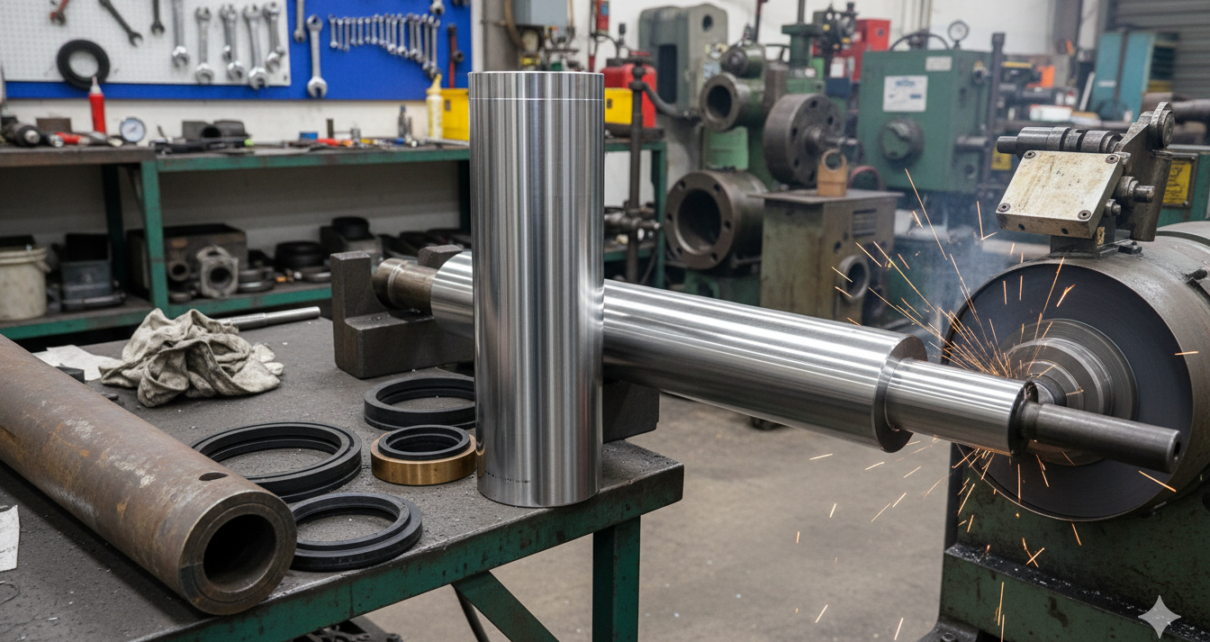
Instead of shelling out for a brand-new rod, a top-tier machine shop will surgically strip the old chrome using reverse electrolysis or precision grinding. They save the core steel. After a serious scrub down, the rod takes a dip in a chemical bath to get electroplated with fresh chromium. Finally, they finish it, a crazy-meticulous belt-sanding process to dial in the exact thickness and texture your seals demand.
Final Word:
The bottom line? Skipping your homework and snagging the cheapest replacement bar is a classic case of penny-wise, pound-foolish. It’ll just bleed you dry later in blown seals and dead machines. Whether you roll with standard plating for the light stuff or induction-hardened steel for the trenches, picking the right rod is the smartest insurance policy you can buy for your heavy machinery.
For a deeper understanding of how each part contributes to system performance, check out our detailed article on selecting the right hydraulic system components for your application.