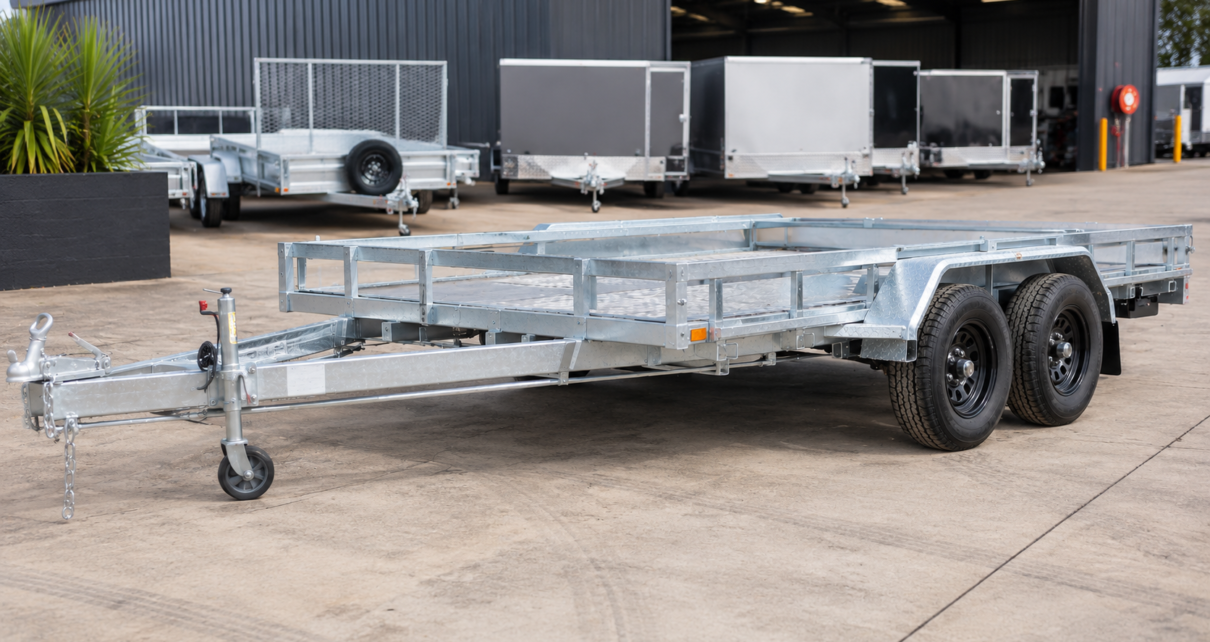
Let’s face it: everyone loves a bargain when hunting for a heavy-duty workhorse to tow behind their rig. But if you’re scrolling through a galvanised trailer sale, don’t let a cheap sticker price blindside you. Getting sucked in by a low upfront cost is easy, but you’ll overlook the long-term nightmare of structural rust, cracked welds, and endless maintenance. In short, the finish is the foundation of your trailer’s lifespan. To avoid your investment dissolving into red dust after a couple of wet winters, know what you’re paying for before handing over your cash.
Painted vs. Hot-Dip Galvanised Finish
When comparing steel finishes, you are looking at two completely different beasts:
- Painted Steel: Think of paint as a basic raincoat. It looks sharp initially, but the first stone chip on the highway rips that barrier open. Moisture slips right in, and rust devours the steel from the inside out.
- Hot-Dip Galvanising: Quite a metal feat! A metal setup gets dipped into molten zinc; then, a layer of a zinc-iron composite is created which covers the entire frame through the process of reaction between zinc and iron. If the surface gets damaged, the exposed zinc part will give up to rust for the protection of the steel underneath. Besides, it is used to safeguard metal areas inaccessible to paint.
Sizing Up Your Payload
First up, match the deck to cargo. Flatbeds make loading awkward machinery a piece of cake. Enclosed box trailers keep gear safe from rain and thieves, while low beds help haul tall loads under low bridges.
But here’s the rub: physical size means nothing if weight ratings don’t stack up. Sizing for your heaviest payload prevents frame fatigue and cracked welds. Proper weight distribution is vital for safety; keep sixty percent of cargo weight in the front half to maintain a stable tow ball load.
Choosing Your Axle Configuration
Now for the big decision: single axle vs tandem axle trailers. Let’s break down how they behave:
- Single Axle: Sporting one axle and two wheels, these are lightweight, inexpensive, and easy to walk. It is also super easy to maintain because it only has two wheels, two hubs, and two bearings. However, Australian regulations limit unbraked trailers to a GVM of 750 kg, and they are also unstable at high speeds.
- Tandem Axle: Built for serious heavy lifting across four wheels, these track beautifully on unsealed roads. If a tyre blows at speed, the remaining three wheels keep you stable. The trade-off is tyre scrubbing during tight turns, and you must budget for the “double everything” rule for tyres, bearings, and brakes.
Springs or Torsion?
Your trailer’s ride depends entirely on the suspension system underneath:
- Leaf Springs: These stacked steel leaves are tough, cheap to repair, and love heavy loads. The downside? They bounce uncontrollably when empty.
- Torsion Axles: These suspension systems have rubber cords in a steel tube and give a very smooth ride with hardly any maintenance needed. Yet, they are expensive to purchase and difficult to repair at the point of failure.
Australian Braking Laws
You can’t just wing it when it comes to stopping power:
- Under 750kg GVM: No brakes required legally.
- 750kg to 2.0 Tonnes GVM: At least a mechanical overrun system is required.
- Over 2.0 Tonnes GVM: You legally need electric brakes on both axles and an automatic breakaway safety system.
Pre-Purchase Used Checklist
If you’re buying used, don’t just assume “she’ll be right.” Inspect these five critical areas:
- Frame Spine: Scan cross-members for flaking rust or cracked welds.
- Coupler Plate: Check for wear around the coupling point.
- Tyres: Uneven tread wear means misaligned axles.
- Floor: Walk the entire deck to find soft, rotten timber.
- Lights: Test that indicators and brake lights function properly.
Conclusion:
Your choice boils down to matching the trailer to your conditions. If you are chasing a high-quality galvanised trailer in Melbourne, our premium range is engineered to survive the worst Aussie roads. Swing by our yard or check us out online today to get sorted.