Small bulbs create more maintenance work than their size suggests. An indicator light costs very little, but replacing one means finding the right part, reaching the fixture, and sometimes shutting down equipment first. Multiply that by dozens of lights that each burn out on their own schedule, and it becomes a regular chore.
LED miniature bulbs remove most of that work. They are small LED lamps built to replace the incandescent miniatures used in indicators, dashboards, signs, and decorative fixtures. They last much longer, draw less power, and run cooler. The only requirement is that the base, voltage, and polarity match what is already installed. Below is why the switch is worth making and what to check before you do it.
What Are LED Miniature Bulbs?
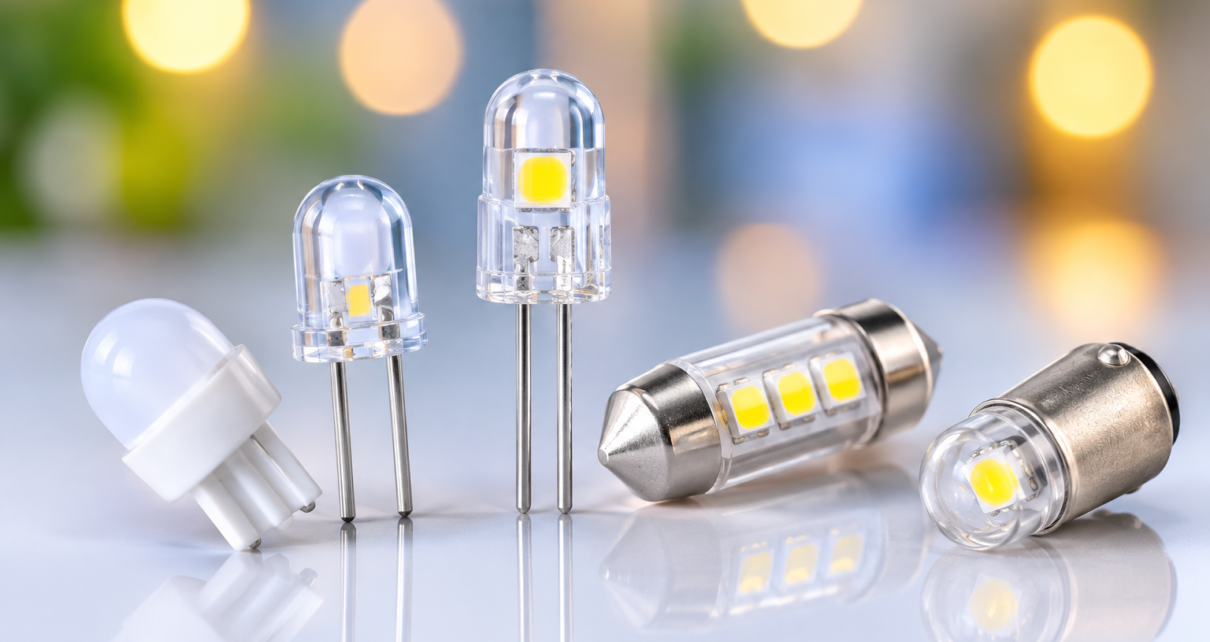
LED miniature bulbs are small LED lamps designed to replace the tiny incandescent bulbs found in indicators, instrument panels, signs, and decorative fixtures. They are also called miniature LED light bulbs, and the two names mean the same thing.
What sets them apart from standard bulbs is the case. Miniature bulbs use a range of connector styles, including festoon, pin, screw, twist-and-lock, and wedge bases. LED miniature bulbs are made in each of these formats, so the LED version of a given bulb normally uses the same connector as the original.
Why Should You Switch to LED Miniature Bulbs?
They last much longer
Incandescent miniatures often burn out within a few thousand hours, and sooner in equipment that runs all day. LED miniature bulbs. LED miniature bulbs are commonly rated at 25,000 to 50,000 hours, depending on the product. In practice, that can mean years between replacements instead of months. For fixtures that are hard to reach, or that require shutting down equipment to service, this matters more than the price of the bulb.
They use less power
An LED miniature draws a fraction of the wattage of the incandescent it replaces. One bulb will not change an electric bill. But a facility with hundreds of indicators, exit signs, and panel lights running around the clock will notice the difference.
They run cooler
Incandescent bulbs turn most of their energy into heat. LEDs stay much cooler, which is easier on the plastic lenses, wiring, and heat-sensitive parts around them. In sealed housings, that means less risk of discolored or warped covers.
They hold up to vibration
A filament can snap when it is shaken or bumped. LEDs have no filament, so they tolerate the vibration found in vehicles, machinery, and aircraft panels much better.
They turn on instantly and come in useful colors
LEDs reach full brightness the moment power reaches them. They are also available in warm white, cool white, and single colors such as red, green, amber, and blue, which helps when an indicator or signal needs a specific color.
Where Are LED Miniature Bulbs Used?
Anywhere a small, reliable light source is needed, including:
- Dashboard and instrument panel lighting
- Equipment status indicators
- Illuminated signs and displays
- Medical and laboratory equipment
- Aerospace and marine panels
- Interior vehicle lighting
- Under-cabinet, landscape, and decorative fixtures
High-use settings benefit most. If a bulb is on all day, or sits somewhere that makes replacement a hassle, an LED pays for itself sooner.
What Should You Check Before Switching?
Most swaps are simple if four specs line up.
| Specs | What to check | Why it matters |
| Base type | Match the existing base (G4, G9, E11/E12, BA15d, festoon, wedge) | The bulb has to physically fit the socket |
| Voltage | Confirm AC or DC and the exact rating | Too much voltage can damage an LED |
| Polarity | Check whether the bulb is polarized or non-polarized | A polarized DC bulb may not light if installed backwards |
| Dimming | Look for a dimmable rating and a compatible dimmer | Most miniature LEDs are not dimmable by default |
The easiest starting point is the old bulb itself. The base, voltage, and size are usually printed on it or on the socket. Festoon bulbs, for example, come in several lengths, and the new bulb has to fit between the contacts. Measuring the old one avoids a mismatch. Festoon LED bulbs are a common case where this check is needed.
If a polarized DC bulb stays dark, pull it out, turn it 180 degrees, and reinsert it. That fixes the problem more often than a faulty bulb does. Non-polarized versions work in either direction and skip the issue entirely.
For brightness, compare lumens rather than watts. Watts only describe how much power a bulb draws, and LEDs deliver far more light per watt than incandescents.
How Much Can You Save?
The following example uses assumed figures that can be adjusted to reflect actual operating conditions.
A facility runs 100 indicator bulbs around the clock, which is 8,760 hours a year. Assume the incandescent bulbs are rated for 2,000 hours and LED replacements for 25,000 hours.
Replacements: The incandescent bulbs would need about 100 swaps a year. The LEDs would need about 35 swaps.
Energy: If each LED draws about 4 watts less than the bulb it replaces, the 100 bulbs save roughly 3,500 kWh a year.
The greater savings often come from reduced labour costs. Every swap means someone’s time, and in equipment that must be shut down for service, those costs add up quickly.
Conclusion
For fixtures that run often or are hard to service, LED miniature bulbs are usually an easy upgrade. They last longer, use less energy, stay cooler, and handle vibration better. Matching the base, voltage, and polarity up front avoids most of the problems people run into.