
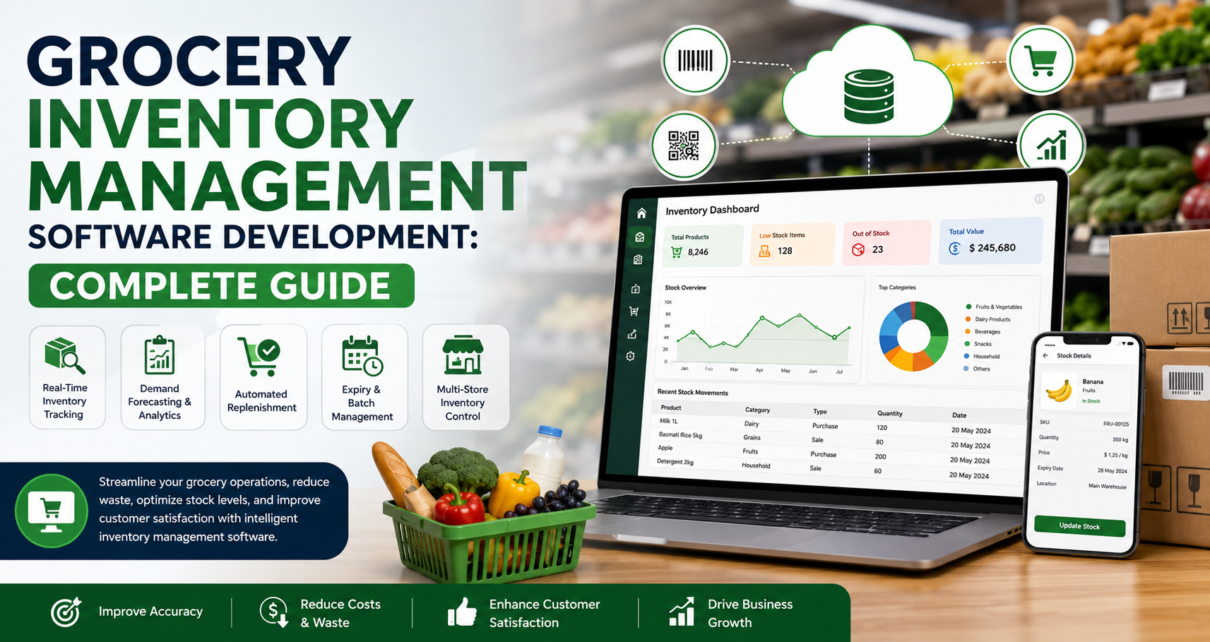
In today’s world, grocery inventory management is no longer limited to keeping track of how many pieces of stock are available on the shelves. In today’s environment of grocery retailing, it is important to manage thousands of SKUs, to monitor the availability of the goods in real-time, reduce wastage of the products, to forecast the demands of consumers, and to ensure that products remain in stock all the time.
This is the reason why grocery inventory management software becomes so important. With its help, you can automate your processes, improve the visibility of your stock, optimize your procurement process, and even make some data-based decisions related to your inventory. If you run a grocery store, convenience store, grocery chain, or any other form of grocery platform, then buying grocery inventory management software will be a good decision for you.
From stock shelves to intelligent systems, this guide will help you understand everything there is to know about grocery inventory management software. These aspects include practical advantages of using such software, the history of its development, effective best practices, and tips on how businesses can develop efficient software to be prepared for the future of grocery.
What is grocery inventory management?
Do you ever think about how grocery stores remain adequately stocked at all times? This process of inventory management in groceries entails systematically maintaining an inventory of all that comes in, from fresh produce and dairy products to packed and frozen items.
This is quite different from the management of other forms of inventory because most of the products sold in a grocery store have an expiry date. It is necessary to take steps to ensure proper management of inventory to avoid overstocking, understocking, or spoilage of inventory items.
Grocery store management is an automation of various processes in relation to inventory, such as stock visibility, barcode scanning, auto purchase orders, expiry dates, supplier management, and sales analytics.
Why Businesses Need Grocery Inventory Management Software Development
With the growth in digitalization of the grocery industry, there has been a need for much better solutions that are not possible with the use of manual spreadsheets or traditional inventory methods.
Inventory software for groceries will assist the organization in making customized applications that would cater to its requirements. Customized software would allow integration of POS systems, ERP systems, warehouse management systems, e-commerce websites, and supplier networks to create a comprehensive inventory solution.
Whether the organization operates a single grocery business or multiple stores, it would be much better with customized inventory software than ready-made software.
Benefits of Grocery Inventory Management Software
Real-Time Inventory Visibility
Real-time inventory tracking allows businesses to be aware of precisely what products are available in their warehouses and on shelves. This allows for a reduction in discrepancies in stock and aids in decision-making by the employees.
Reduced Food Waste
Since food from the grocery stores has a very short lifespan, the inventory management system monitors the time until the products expire and works on the basis of the FIFO (First In, First Out) technique.
Accurate Demand Forecasting
The inventory management system makes forecasts about future demand through past demand statistics, seasonal demand, promotions, and buyer behavior.
Better Supplier Management
The inventory system makes communication with vendors easier through automated purchase orders, performance monitoring of suppliers, and scheduling of deliveries. This improves the relationship with suppliers and ensures replenishment of stock in time.
Improved Customer Satisfaction
Customers have high expectations that there will be sufficient stock when they come to the stores or order online. Proper inventory makes order processing easier and creates a good shopping experience.
Essential Features of Grocery Store Inventory Management Software
An effective grocery store inventory management software should include the following:
1. Real-Time Inventory Tracking
Monitor the status of inventory in real time at all sales points or warehouses through automatic updates following each purchase or sale. This will help in avoiding inventory discrepancies, increasing accuracy, and faster decision-making.
2. Barcode & QR Code Scanning
Scan your items through barcodes/QR codes during inventory management tasks such as receiving items, selling them, or conducting a stock audit. This will save on manual data entry and speed the process.
3. Automated Stock Replenishment
Automatically generate purchase orders by setting a threshold of inventory for each item or alert you whenever an item’s inventory is running low.
4. Expiry Date Management
Track expiration dates for perishable products and prioritize older inventory using FIFO practices. This minimizes food waste, improves product freshness, reduces financial losses, and enhances customer satisfaction.
5. Supplier Management
Handle supplier data, orders, deliveries, and supplier performance management through a single integrated system. Good supplier management leads to a prompt procurement process, favorable prices, and efficient replenishment of inventory across different places.
6. Demand Forecasting & Analytics
Use sales figures from the past, seasonality of the market, and customer behavior to make demand forecasts. Better forecasting of demand will help you manage your inventory and improve profitability.
7. Multi-Store Inventory Management
Manage inventory of various grocery stores and warehouses through a single integrated platform. Coordinate inventory management and product transfers and track inventory of each place.
Steps in Managing Grocery Inventory
Step 1: Analyze Inventory Requirements
Start with defining the product categories, number of items, places of storage, warehouse capacity, and business goals. Knowledge of operational requirements will help you develop the appropriate strategy of inventory management.
Step 2: Classify Products
Products should be divided into categories such as fresh products, frozen products, beverages, dairy products, everyday items, and packaged food.
Step 3: Implement Barcode or QR Code Tracking
Assign unique barcodes or QR codes to every product for faster stock updates, improved accuracy, and reduced manual entry errors.
Step 4: Track Inventory in Real Time
All purchases, sales, returns, transfers, adjustments, etc. need to be recorded automatically to keep your inventory up-to-date.
Step 5: Set Minimum and Maximum Stock Levels
Every item will have the corresponding stock level set in the system. If there is the minimum stock level left, the system will automatically send a notification about the need for reorder.
Step 6: Monitor Expiration Dates
Track expiry dates continuously and prioritize products nearing expiration to reduce waste and maximize profitability.
Step 7: Forecast Customer Demand
Analyze sales history, seasonal trends, holidays, and promotions to estimate future demand and avoid unnecessary overstocking.
Step 8: Automate Purchase Orders
Generate purchase orders automatically based on inventory levels, supplier lead times, and demand forecasts.
Step 9: Perform Inventory Audits
The process will help you check whether your inventory matches your accounting records and find out discrepancies resulting from losses due to theft or any other factor.
Step 10: Generate Business Reports
Analyze inventory performance through dashboards showing stock movement, supplier efficiency, product profitability, inventory turnover, and purchasing patterns.
Technologies Used in Grocery Inventory Software Development
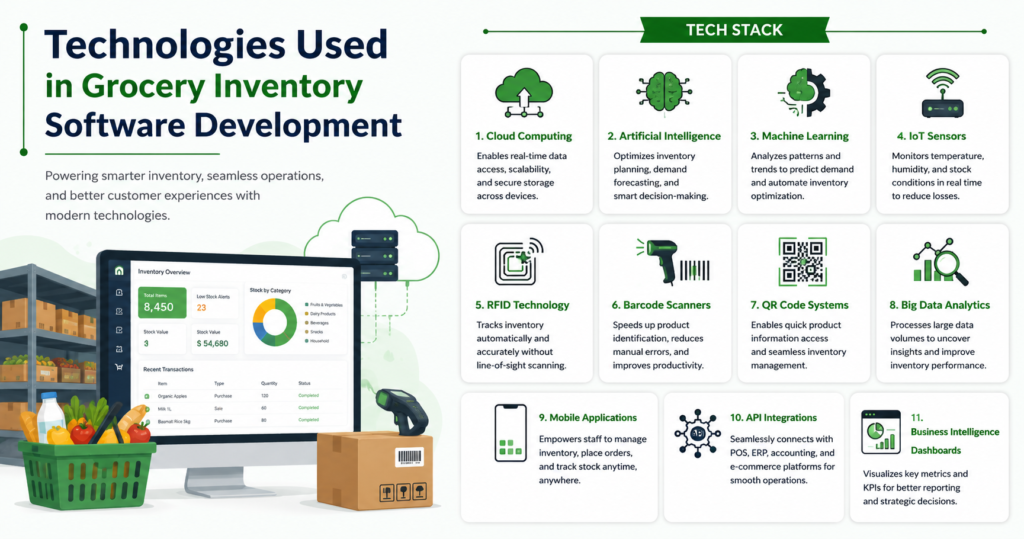
Inventory management software, which is currently in use in groceries, is based on highly sophisticated technologies that ensure high levels of accuracy in stock management automation and decision-making. These technologies include cloud computing, artificial intelligence, machine learning, IoT, RFID, barcodes, QR codes, big data analytics, mobile technologies, APIs, and business intelligence.
Overcoming Challenges with Tried and Tested Technology and Best Practices
Inventory Inaccuracy
Human errors in stock management may lead to discrepancies. Barcode scanning, RFID tagging, and real-time synchronization greatly increase the accuracy of inventory.
Overstocking
Too much inventory leads to higher storage costs and food spoilage. AI-driven forecasting technology enables businesses to buy goods in accordance with demand.
Stockouts
Insufficient quantities of popular goods harm customer experience. Reordering systems make sure that the required amount of goods is bought before it gets too low.
Product Expiration
Foods need to be tracked carefully. The expiration tracking and FIFO rotation system reduce waste and increase profits.
Multiple Store Management
Inventory management may be challenging when you have many branches. The cloud-based inventory management system makes it easier to track all stores from one dashboard.
Supplier Delays
Supplier performance tracking helps businesses identify unreliable vendors and maintain backup supplier networks to avoid disruptions.
Warehouse Inefficiencies
Warehouse management tools improve the process of organizing warehouses, picking routes, and moving stocks, which results in quicker order processing.
Lack of Data Visibility
Interactive dashboards give business owners the information about inventory state and sales performance in real time.
Role of Inventory Software in Online Grocery Businesses
In this regard, as online grocery shopping expands, there is a need for proper inventory management. There is a need for businesses with an on-demand grocery delivery app to manage their inventories in real time in physical stores, warehouses, and the digital domain.
Inventory software allows customers to view items in the inventory, thus minimizing cases of cancellations and boosting customer trust. It will also enable fast order processing and accurate delivery promises.
It is crucial for organizations that intend to go through digital transformation to integrate their inventory management with eCommerce platforms.
Future Trends in Grocery Inventory Management
Emerging technologies continue to reshape grocery inventory operations. Businesses can expect increased adoption of:
AI-Powered Demand Forecasting
The AI system will look at sales trends, customer behavior, seasonality, and trends in the marketplace to predict demand and avoid both surplus inventory and lack of inventory.
Real-Time Inventory Tracking
The sophisticated tracking system provides real-time monitoring of inventory at stores and warehouses and through delivery mechanisms, ensuring quick and efficient replenishment of inventory.
Automated Inventory Replenishment
Intelligent systems will create purchase orders automatically based on inventory needs, supplier availability, and forecasts of demand.
Predictive Analytics
Predictive analytics helps grocery businesses identify buying patterns, predict future inventory requirements, manage inventory, and make informed decisions.
How to Choose the Right Development Partner with Helpful Insight
Finding a tech partner who would develop a scalable inventory system is one of the crucial steps on your way. A company specializing in grocery delivery app development is well aware of all the challenges that arise in this industry, including inventory automation, warehouse management, collaboration with suppliers, omnichannel retail, etc.
Efficient inventory management is among the essential factors of success for a grocery store. Whether it is reduced waste and stockouts, higher customer satisfaction, or additional revenue generation, an effective inventory management approach will definitely bring results.
An inventory management system for a grocery store enables process automation, real-time inventory tracking, purchase optimization, and business scaling. In light of rising customer requirements, implementing efficient inventory management technologies is no longer an option but a must.
If you were planning to create an inventory management system for a grocery store, we could help. Our company, Helpful Insight, focuses on creating innovative software solutions for businesses.