Imagine waking up in a house that just gets you. No more struggling with narrow hallways or worrying about slipping in the shower. For lots of Aussies on the National Disability Insurance Scheme, this isn’t just a dream; it’s a daily reality made possible through expert property adjustments. Whether you’re living with a physical disability or planning for the future, getting the right structural changes sorted can bring back your independence. That’s exactly the point where registered NDIS home builders in Melbourne come in. They convert clinical reports into handy daily living aids that help individuals feel dignified and comfortable for life.
Teaming Up with the Right Professionals
Why can’t one just hire any local professional? Changing a house to make it more accessible is very specialised work. Registered builders need to comply with a very strict National Construction Code and SDA Design Standards. In other words, whatever they build is strong, safe, and top-notch in terms of standards. The main idea is to make areas that are so sturdy that they will last through the wear and tear of daily life for many years.
So, working with a licensed professional would be so much better and here is why:
- They are fluent in the language of Occupational Therapist (OT): They collaborate with OTs to make sure that clinical recommendations truly work in the real world, so that there will be less need for frustrating back-and-forth communication.
- Funding experts: Seasoned teams are well-versed with the funding process, and they know how to break down quotes and project scopes to get your applications approved.
- Enjoy project management without worries: A professional as a Building Works Project Manager can take the stress off you by organising all different trades, controlling timelines and making sure everything is strictly on schedule.
Smart Tweaks Inside the House
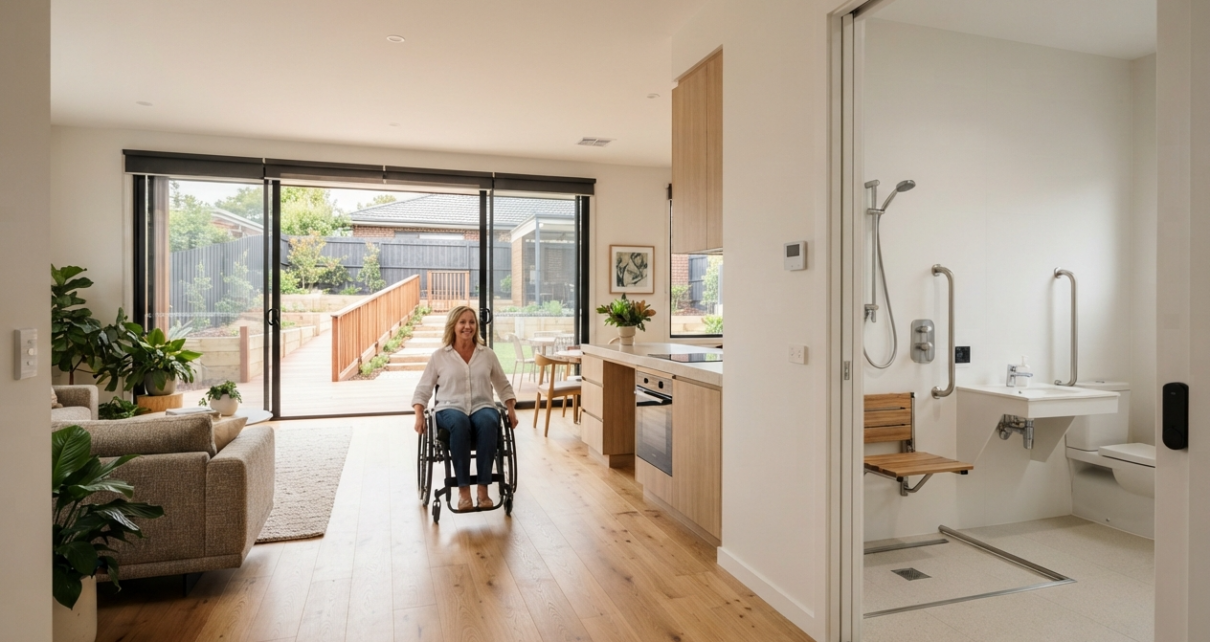
Every day movement around your home should be completely effortless. To help with this, construction teams often widen internal doorways to a minimum of 920mm, making wheelchair circulation an absolute breeze. They might also lay down slip-resistant hybrid flooring or add curved feature walls to stop tight, awkward corners from getting in your way.
Plainly put, a bathroom is where paramount safety must be ensured. If you are thinking about how to optimise your bathroom for convenience, then hygiene and safety should be your priorities at all times.
Experts use a number of strategies to create safe and functional interior spaces, including:
- Accessible Bathrooms: Builders remove part of the bath to facilitate easy access, install devices to prevent scalding, and provide folding shower seats. Also, they put up grab rails at the right points and make ceiling structures strong enough for hoist transfers.
- Customised Kitchens: Modified kitchen islands with proper mobility clearances and accessible overhangs mean you can prep meals independently without bumping your knees into cabinets.
Taking Care of the Great Outdoors
Out there beyond the front door, life keeps moving. Community connection matters just as much as comfort indoors when it comes to feeling well. Yet cracked sidewalks, tight entryways, or high steps often turn simple walks into daily hassles. Fixing what lies outside your walls holds the same weight as rearranging the couch by the window.
When it comes to major outdoor home renovations, the goal is usually to create smooth, stepless access and reduce the burden of yard upkeep.
Builders improve outdoor areas by:
- Upgrading Entrances: Building custom wooden decking that sits flush with your exits, installing platform lifts, or adding gentle external ramps.
- Safer Pathways: Replacing slippery, standard concrete with exposed aggregate paths for much better grip and flattening out any tripping hazards.
- Low-Maintenance Gardens: Swapping demanding lawns for easy-care gravel, adding raised garden beds so you can keep up a gardening hobby, and installing automated gates.
Future-Proofing with Clever Tech
We live in a modern world, and assistive technology is completely changing the game for accessibility. Today’s modifications often include built-in automation that gives you control over your environment using just your voice or a smartphone.
Some very clever technology updates are:
- Automated Fixtures: Picture changing the temperature, turning down the lights, or unlocking the door without actually going to the switch.
- AI-Powered Safety: When someone trips or their heart acts strangely, smart gear spots it fast. Machines today pair artificial brains with wristbands that notice trouble. Alerts go out instantly, so helpers know what’s up. Works like a quiet guard watching over things. Gives peace without making noise.
- Smart Security: Always knowing who stands at your door becomes possible when video doorbells meet face-scanning tools. Remote monitoring ties it together, linking pieces without extra effort. A system watches, recognises, then reports – simple steps adding up quietly behind the scenes.
Conclusion:
Home changes let you shape life just the way it should be. Start chatting with your occupational therapist and contractor today – ideas take root when real talk begins. Designing a space that fits right now matters, just like planning for what comes later. Smooth moves today support bigger steps tomorrow. Living fully starts where you stand, not somewhere down the road.