
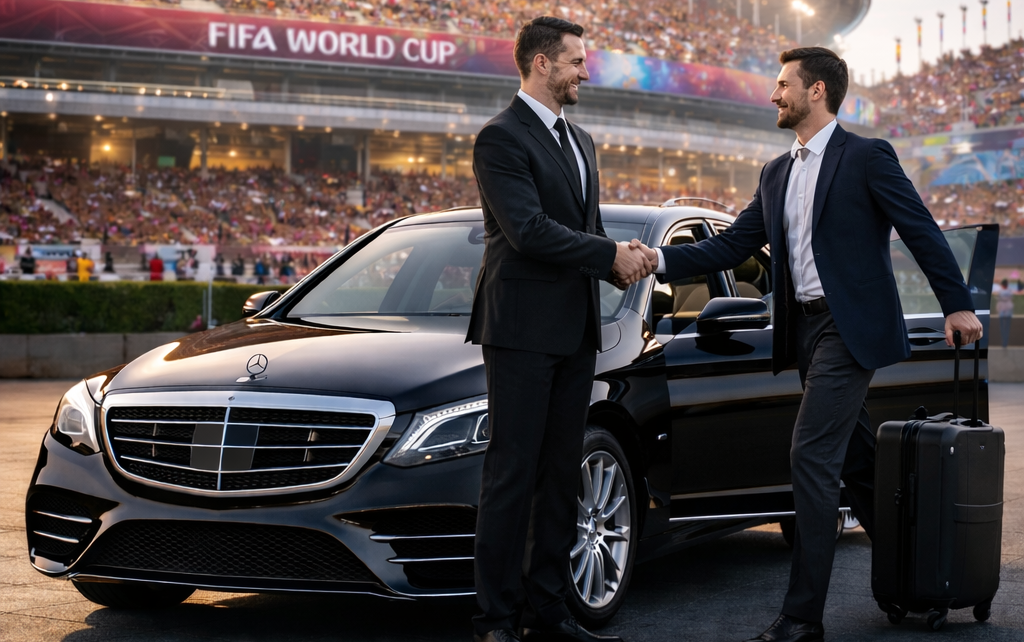
The 2026 FIFA World Cup is unlike anything North America has ever seen. Sixteen cities. Three countries. 104 matches. Millions of fans. Getting to the game is half the battle. Here’s how to do it right.
| Figure | Detail |
| 16 | Host Cities |
| 104 | Total Matches |
| 48 | Nations Competing |
| 39 | Days of Play |
Let’s be honest. When you’re flying halfway across the world to watch your team play, the last thing you want to do is stand in a rideshare queue for 90 minutes after the match ends. But that’s exactly what’s going to happen to millions of fans who didn’t plan their ground transportation ahead of time.
The 2026 FIFA World Cup runs from June 11 to July 19, spreading across 16 host cities in the United States, Canada, and Mexico. It’s the first World Cup ever hosted by three nations simultaneously, and it will be the largest edition in tournament history. That scale brings incredible excitement — and equally incredible logistical challenges.
If you have secured match tickets, sorted your accommodation, and booked your flights, there’s one more piece of the puzzle that most fans overlook until it’s too late: how you actually get to the stadium and back.
The Problem With “Figuring It Out on the Day”
Every World Cup host city will see hundreds of thousands of visitors on match days. Take MetLife Stadium in New Jersey, which hosts eight matches, including the Final on July 19; it holds over 82,500 fans per game. FIFA has already confirmed there will be no general parking at the venue. Public transit prices from Manhattan are reportedly climbing to $150 per person on peak match days.
In Houston, the 610 Loop around NRG Stadium, which hosts seven fixtures, is notorious for gridlock even on regular event days. In Dallas, road closures around AT&T Stadium can stretch for miles. And in Los Angeles, traffic needs no introduction.
Rideshare apps like Uber and Lyft will be available, but they will also be experiencing surge pricing, severe pickup congestion, and driver shortages at exactly the moment 80,000 fans all open their phones at once. The math simply doesn’t work in your favour.
Why a Pre-Booked Car Service Changes Everything
A professional car service removes the three biggest variables of World Cup travel: unpredictable pricing, uncertain availability, and post-match chaos. When you book in advance, you lock in your vehicle, your rate, and your chauffeur — none of which can be “surge priced” away from you at 10 PM after a tense semifinal.
Professional chauffeurs are experienced with event-day routing. They know which roads close, where the official drop-off zones are, and how to position for pickup before the crowd hits. For VIP access, many private car services can drop you significantly closer to stadium gates than any public transport stop or rideshare waiting area.
Pro tip: Book your stadium transfer at the same time as your match tickets. Transportation availability — especially Sprinter vans and larger vehicles — sells out well before game day for high-profile fixtures.
Matching the Right Vehicle to Your Group
One of the underrated advantages of using a car service for FIFA world cup 2026 is the flexibility it offers based on your group size and situation. Traveling solo or as a couple? A luxury sedan or executive car gets you door-to-door in comfort and privacy. Group of six headed to the Dallas semifinal? An executive SUV often works out cheaper per person than surge-priced rideshare, and everyone arrives together, on time.
For larger fan groups, supporter clubs, or corporate hospitality parties, Sprinter vans (typically seating up to 12) and mini-coaches are popular choices. They allow for coordinated pick-up from multiple hotels, a shared pre-match atmosphere, and organised departure after the final whistle; no one gets left behind.
Families travelling with young children benefit particularly from pre-booked services, since child seats can be arranged in advance, something no rideshare app can reliably guarantee in a pinch.
The Host Cities and What to Expect on the Ground
The 16 World Cup venues span three geographic regions across North America. Each city presents its own transport picture:
| # | City | Stadium | Matches | Highlight |
| 1 | New York / New Jersey | MetLife Stadium | 8 | Final venue |
| 2 | Los Angeles | SoFi Stadium | 6 | — |
| 3 | Dallas | AT&T Stadium | — | Semifinal |
| 4 | Atlanta | Mercedes-Benz Stadium | — | Semifinal |
| 5 | Houston | NRG Stadium | 7 | — |
| 6 | Miami | Hard Rock Stadium | 6 | — |
| 7 | Seattle | Lumen Field | 5 | — |
| 8 | Toronto | BMO Field | 6 | — |
| 9 | Mexico City | Estadio Azteca | — | Opening match |
| 10 | Vancouver | BC Place | 7 | — |
| 11 | Boston | Gillette Stadium | — | — |
| 12 | Philadelphia | Lincoln Financial Field | — | — |
For fans following their team across multiple cities, a very common scenario in a tournament this large, coordinating airport-to-hotel and hotel-to-stadium transfers through a single car service provider makes the whole trip smoother. Many companies now offer city-to-city coordination and can handle multi-leg itineraries across the tournament window.
Airport Transfers: The Part Everyone Forgets
International fans arriving at JFK, LAX, O’Hare, or any other major hub will land into one of the busiest airport periods in recent American history. A pre-arranged airport transfer with a meet-and-greet at baggage claim, flight tracking, and luggage assistance is a world away from fighting for a cab rank after a 10-hour flight.
It also matters for the journey home. If your team’s run ends at the quarterfinals and you need to catch an early morning departure, having a confirmed car already scheduled takes one enormous stressor off your plate.
How Far in Advance Should You Book?
The general guidance from transportation providers is to book two to four months ahead for high-profile matches, semifinals, the Final, or any game involving a major footballing nation. For group-stage fixtures, four to six weeks is a reasonable minimum. Sprinter vans and larger vehicles tend to go first, so if you’re travelling as a group, move sooner rather than later.
Worth remembering: The World Cup Final at MetLife Stadium on July 19 will be watched by an estimated four billion people globally. The New York metro area will be unlike anything it has experienced before. If you’re going, your transport should already be confirmed.
The Bottom Line
The FIFA World Cup 2026 is a once-in-a-generation event for North America. Tickets are expensive. Flights are expensive. Hotels are expensive. After investing that much in the experience, arriving stressed, late, or stranded because of a transportation gamble is the one avoidable regret.
A professional car service is not a luxury add-on for this tournament; it’s genuinely the most practical, predictable, and often cost-competitive way to move between airports, hotels, and stadiums across 39 days of World Cup football. Book it early, lock in your vehicle, and save the adrenaline for the match itself.