
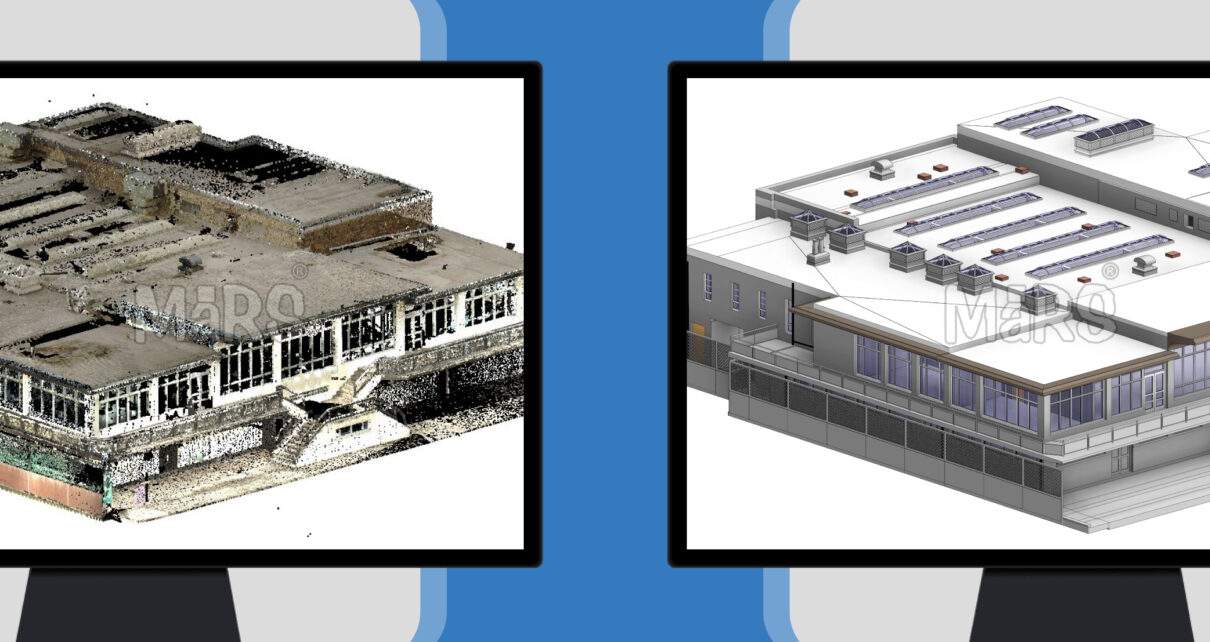
Older commercial buildings often conceal structural issues that traditional inspections fail to detect. Decades of unrecorded renovations, material degradation, and changing load demands create hidden stresses that compromise safety and stability. Scan to BIM transforms these uncertainties into precise, actionable data by capturing millimeter-accurate geometry, detecting concealed defects, and generating intelligent digital models. This technology enables engineers to assess structural integrity, plan reinforcements, and prevent failures before renovation, retrofit, or tenant fit-out work begins.
Why Structural Failures in Old Commercial Buildings Are Rising
Aging Infrastructure vs Modern Load Demands
Old commercial buildings were designed decades ago to support lighter loads and simpler mechanical systems. Tenants introduce heavier equipment, dense occupancy, advanced HVAC systems, and complex utilities that exceed the original structural capacity. Beams, slabs, and columns experience additional stress that remains invisible without high-resolution scanning. Traditional structural assumptions fail to reflect these real-world pressures, creating a mismatch between legacy design and current usage.
Structural materials degrade naturally due to age, environmental exposure, and repeated load cycles. Concrete carbonation, steel corrosion, and minor settlements reduce load-bearing capacity, while small deformations intensify over time. Engineers using only original drawings or incomplete surveys cannot accurately assess how these changes affect safety or stability. Scan to BIM captures true as-built conditions, allowing engineers to evaluate load paths, slab deflection, and material integrity with precision.
Why Visual Inspections Often Fail
Visual inspections remain the most common method for assessing structural health, but they detect only what is exposed or visible. Hidden cracks, displaced beams, uneven slabs, or misaligned columns frequently go unnoticed, especially when concealed behind finishes or ceilings. Even experienced inspectors cannot reliably measure subtle deflections or hidden geometric distortions. This limitation results in 60–70% of structural risks going undetected, leaving buildings vulnerable during renovation, tenant fit-out, or equipment upgrades.
Manual inspections often rely on spot checks and sampling rather than analyzing the entire structure. Engineers make assumptions about geometry, load distribution, and material condition, increasing the likelihood of miscalculations. Critical issues such as uneven slab thickness, warped beams, or shifted columns remain hidden until they trigger noticeable structural problems. Scan-to-BIM creates a dense point cloud representation of every structural element, replacing guesswork with measurable data for precise analysis.
Financial and Safety Impacts
Undetected Structural Scan to BIM issues increase project costs and compromise safety. Discoveries during demolition, retrofit, or modernization work lead to emergency reinforcements, schedule delays, and unplanned material expenditures. They endanger occupants and construction teams. Scan to BIM allows engineers to identify structural vulnerabilities before work begins, reducing safety hazards and minimizing costly disruptions.
The Hidden Risk in Aging Commercial Buildings
- Missing/Inaccurate Drawings
Legacy buildings often lack complete or reliable as-built drawings. Over decades, undocumented alterations, structural modifications, and retrofits accumulate. Engineers relying on assumptions face increased risk of design errors, misaligned reinforcements, or unsafe retrofits.
- Material Degradation
Concrete carbonation, steel corrosion, slab deflection, and fatigue develop internally long before surface cracks appear. Dense point cloud scans, combined with image-enhanced data, allow detection of spalling, cracks, and deformation invisible.
- Historical Modifications
Old buildings experience misaligned columns, warped walls, uneven slabs, and load-path conflicts caused by decades of settlement and undocumented renovations. Scan to BIM enables early detection of structural misalignments and deviations, preventing unsafe interventions during renovation or retrofits.
How Scan to BIM Converts Hidden Conditions into Measurable Data
Millimeter-Accurate Geometry Capture
High-density 3D laser scanning record beams, slabs, columns, walls, and foundations with millimeter-level accuracy. These scans eliminate assumptions based on outdated or missing drawings and reveal the true structural geometry. Engineers can detect subtle deviations, uneven slabs, warped walls, misaligned columns, and other hidden defects that traditional surveys fail to capture. This detailed geometry forms a reliable basis for load analysis, structural simulations, and retrofit planning.
Intelligent BIM Modeling
Raw point cloud data converts into LOD 300–400 Revit-based BIM models, creating intelligent digital twins of the existing structure. These models allow engineers to analyze load paths, structural alignments, member behavior, and stress distribution before any demolition or renovation begins. BIM models support predictive structural analysis, clash detection with new MEP installations, and planning for reinforcements or retrofits with precise, quantifiable data.
Clear Scope and Risk-Focused Scanning
Defining the structural investigation scope before scanning ensures that critical elements, such as beams, slabs, columns, foundations, and load-bearing walls, are included. These are captured at the required resolution. Targeted scanning prevents structural blind spots and provides engineers with actionable information for decision-making. Focused, risk-driven data capture highlights potential weak points, settlement distortions, and historical alterations, enabling safer renovation and retrofit planning.
Digital Forensics: Revealing Concealed Structural Issues
Hidden Deformations and Misalignments
Scan to BIM detects misaligned columns, rotated walls, displaced slabs, and uneven beams. Even non-orthogonal geometry, slab deflections, and out-of-plumb walls become measurable, allowing proactive structural interventions.
Concealed Damage Behind Finishes
Cracks, voids, corrosion, embedded MEP systems, and prior repair areas often remain hidden during visual inspections. Point clouds combined with high-resolution images uncover these concealed structural threats before they compromise load-bearing elements.
Comparison With Original Design Intent
By overlaying as-built scan data on original drawings, engineers can identify deviations, uncover undocumented retrofits, and highlight high-risk zones through color-coded heat maps. This enables precise prioritization of structural reinforcement and remediation.
Enhancing Structural Accuracy With Point Cloud & Image Integration
Integrating high-resolution images with dense point cloud data improves the accuracy of structural assessments ind ol commercial buildings. This combined approach allows engineers to detect surface deterioration, such as cracks, spalling, corrosion, and irregularities, that often go unnoticed in visual inspections. Rigorous registration and quality control processes prevent misaligned or noisy data from affecting analysis, giving engineers validated, precise information for decision-making. The integration also enables quantifiable measurement of structural displacements, deflections, and distortions, reducing reliance on assumptions from legacy surveys and providing actionable data for renovation, retrofit, or reinforcement planning.
Key benefits
- Enhances visualization of fine structural details for clearer assessment.
- Supports early identification of vulnerable structural zones.
- Facilitates digital documentation for long-term monitoring and audits.
- Provides objective data for planning targeted repairs and retrofits.
Early Structural Risk Detection and Clash Prevention
Load-Path Conflicts
Scan-to-BIM identifies structural clashes between existing beams, slabs, columns, and new MEP retrofits. This ensures safe integration of modern utilities without risking structural compromise.
Structural Misalignment Prioritization
Deviation analysis flags critical misalignments, deflections, and tolerance failures, enabling teams to prioritize reinforcement zones and prevent failures during renovation.
Reducing Rework and Operational Disruption
By detecting risks digitally, renovation or retrofit teams can avoid on-site trial-and-error, reducing rework, safety incidents, and schedule delays, especially in active commercial buildings.
Forensic-Level Structural Assessment With BIM
Digital twins created from Scan to BIM data allow engineers to simulate structural behavior, analyzing load-bearing capacity, deflection, and member performance before renovations or expansions, reducing the risk of unexpected failures. AI-driven segmentation accelerates identification of misclassified or deformed elements, supporting predictive maintenance and long-term monitoring of structural deterioration. Verified digital models replace subjective inspections, providing objective data for regulatory approvals, insurance validation, and forensic audits, while permanent digital records maintain compliance and asset safety over time.
Preserving Heritage and Active Commercial Buildings
Non-Invasive Investigation
Scan to BIM captures detailed structural data without demolition or disruption, allowing engineers to inspect heritage sites, hospitals, or active commercial offices while operations continue. This approach reveals hidden issues behind walls, ceilings, and finishes. Engineers can plan interventions without altering the original structure.
Targeted Reinforcement Planning
Digital BIM models guide engineers to focus reinforcement on vulnerable zones, avoiding unnecessary demolition. This method preserves the integrity of original structures while addressing safety concerns. Data-driven insights prioritize areas with structural risk.
Phased Rehabilitation
Digitally verified models enable engineers to plan sequenced retrofit strategies, allowing construction in phases. This prevents destabilizing the building or interrupting ongoing operations. Each phase is executed based on verified structural data for safety and efficiency.
Structural Monitoring and Digital Twin Benefits
- Time-stamped digital twins track long-term changes in slab thickness, beam depths, and member alignment over time
- Engineers forecast potential failures and high-risk zones to plan preventive interventions that reduce downtime and costly surprises
- Digital twins provide verified structural data for future renovations, expansions, and tenant fit-outs minimizing uncertainty in decision-making
- Continuous monitoring identifies emerging cracks, deflections, and distortions before they escalate into serious structural issues
- Verified digital records support regulatory audits, insurance validation, and safety compliance for aging commercial buildings
- Predictive modeling allows phased maintenance and retrofitting without disrupting building operations or structural stability
Financial and Safety Advantages of Scan-to-BIM
- Avoids costly surprises
- Reduces rework
- Prevents downtime
- Optimizes reinforcement
- Protects asset value
Rapid Decision-Making and Engineering Efficiency
Scan-to-BIM accelerates structural assessment by automating up to 80% of point cloud interpretation while retaining expert oversight. Engineers, architects, and contractors work from a single validated digital model, eliminating assumptions and conflicts in buildings with missing or outdated drawings. Accurate measurements of beams, slabs, columns, and reinforcements support precise quantity take-offs and material planning, reducing on-site adjustments.
Conclusion
Scan to BIM for Structural Safety transforms heritage buildings by capturing millimeter-accurate geometry. It detects hidden structural defects and prevents clashes with new designs. It allows predictive analysis for potential failures. Scan to BIM reduces risks in aging buildings. It preserves heritage structures during modernization. It improves regulatory compliance and insurance confidence. It supports long-term facility management and lifecycle planning. Scan to BIM provides a data-driven foundation for renovation, retrofit, and modernization projects. It safeguards structural safety and reduces financial risks.