
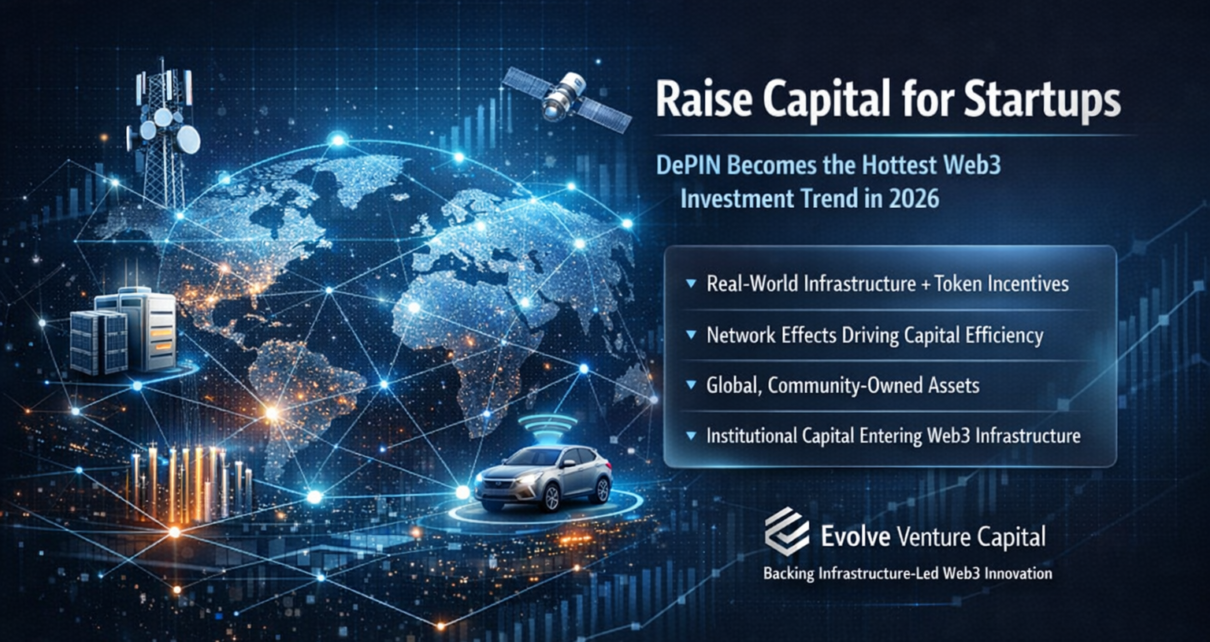
Web3 funding is back and roaring in 2026, and this time, the money is going into something far more practical than the hype cycles of years past. Investors aren’t throwing money at token plays anymore. They’re pouring it into blockchain-based systems that are building real-world infrastructure. And the fastest-growing segment of this new wave of Web3 investment is DePIN, or Decentralized Physical Infrastructure Networks.
DePIN is suddenly a hot topic because it’s about incentivizing real-world physical infrastructure, like wireless networks, cloud storage, maps, energy, and Internet of Things connectivity, using blockchain incentives. So, essentially, DePIN startups are using crypto-inspired models to incentivize individuals and businesses to build physical infrastructure more quickly than anyone else can.
From our perspective here at Evolve Venture Capital, we believe DePIN is the most commercially compelling trend in Web3 right now, especially in early 2026. It’s not a speculative market. It’s an infrastructure market. And that’s a critical distinction, because it’s where long-term value is created, and it’s where we believe venture capital can create long-term value.
For founders, DePIN also creates one of the strongest opportunities today to Raise Capital for Startups because investors are actively searching for Web3 companies with real utility and measurable adoption.
Why DePIN Is Becoming a Global Funding Magnet
The reason DePIN is attracting capital is because it solves a real scaling problem. Traditional infrastructure companies require massive upfront investment, slow rollout cycles, and centralized ownership. DePIN flips that model by distributing ownership and rewards to participants who contribute infrastructure.
This allows networks to scale faster because they are not limited by a single company’s budget. Instead, thousands of contributors can build coverage in parallel. When that system works, adoption grows quickly, and network effects become extremely strong.
In 2026, investors are paying attention because DePIN is no longer just a concept. Real DePIN networks have demonstrated growth, user participation, and increasing demand from industries that need decentralized infrastructure. Wireless coverage networks, decentralized cloud storage, and sensor networks are all gaining traction.
At Evolve Venture Capital, we see DePIN as one of the rare Web3 sectors where the product has visible real-world impact. This is exactly what venture investors want after years of speculative cycles.
That is why venture capital investing in early stage startups is increasing rapidly in DePIN. The sector offers early-stage valuations with large-scale upside potential.
The Viral Keyword in Web3 Right Now: DePIN Venture Funding
The trending keyword dominating Web3 founder communities and investor discussions is DePIN venture funding. This trend has grown because DePIN creates a clear path to adoption. Instead of needing users to speculate on tokens, DePIN companies attract users by offering real utility and incentives.
DePIN venture funding is also rising because the business model is measurable. Investors can evaluate growth through network expansion metrics, contributor activity, hardware deployments, and real customer demand. This is much easier to validate than many traditional crypto startups.
DePIN is also viral because it aligns with major global themes. Countries want better connectivity. Enterprises want cheaper cloud services. Consumers want decentralized alternatives to centralized monopolies. DePIN sits at the intersection of all these demands.
From the Evolve Venture Capital viewpoint, DePIN is trending because it represents Web3’s evolution into real infrastructure and real business fundamentals.
What Types of DePIN Startups Are Getting Funded in 2026
DePIN is a broad category, but the most investable startups in 2026 are those building infrastructure that can scale quickly and integrate with existing markets. Wireless networks are one major area. Startups are building decentralized mobile and IoT connectivity networks powered by community-owned nodes.
Decentralized cloud storage and compute infrastructure is another major segment. Businesses want alternatives to centralized providers because cost and dependency risk are increasing. DePIN startups offering distributed compute resources can potentially compete by providing cheaper and more resilient networks.
Another fast-growing segment is decentralized mapping and sensor infrastructure. These networks gather real-world data that can be used for logistics, mobility, and smart city development. As AI adoption grows, demand for real-world datasets is rising, and DePIN networks are positioned to supply it.
This is why DePIN is attractive to investors. It is not just “crypto.” It is a new way to build global infrastructure.
For founders planning to Raise Capital for Startups, DePIN is one of the strongest narratives today because it combines Web3 scalability with real-world economic demand.
Why DePIN Is a Perfect Fit for Early-Stage Venture Capital
DePIN companies often grow through network effects. Once infrastructure is deployed, each additional participant increases network value. This creates a compounding growth curve that can scale much faster than traditional infrastructure businesses.
That growth pattern is exactly what venture capital looks for. Early-stage investors want markets where small initial capital can unlock massive long-term value. DePIN fits that model because contributors build the network alongside the company.
However, DePIN also requires careful execution. Hardware deployment, incentive structures, token economics, and network security must be designed correctly. If incentives are misaligned, networks collapse. That is why DePIN startups must show strong leadership and clear governance.
At Evolve Venture Capital, we believe DePIN founders need both technical expertise and operational discipline. Building infrastructure is not only a product challenge. It is a logistics challenge and a trust challenge.
This is why a strong venture capital firm can provide significant value in DePIN. The right investors help founders scale sustainably rather than chasing unsustainable growth.
What Investors Expect Before Funding a DePIN Startup
Investors are more disciplined in 2026 than they were in earlier Web3 cycles. They want proof that the network is real and that the adoption is not artificially inflated.
Founders must show clear metrics such as active nodes, geographic coverage, contributor retention, and customer demand. They must also prove that the token model supports long-term sustainability rather than short-term incentives.
Regulatory positioning is also becoming more important. DePIN networks operate globally, and founders must demonstrate that they understand compliance risks related to token issuance and infrastructure operations.
For founders looking to Raise Capital for Startups, this means fundraising requires a structured plan. Investors want milestone-based execution, strong governance, and measurable adoption indicators.
At Evolve Venture Capital, we often advise DePIN founders to treat fundraising as a staged strategy. Early funding validates network deployment. Later funding scales enterprise partnerships and monetization.
Evolve Venture Capital’s Perspective on the DePIN Boom
At Evolve Venture Capital, we see DePIN as one of the most important Web3 investment trends of 2026 because it represents real infrastructure ownership shifting into decentralized models. If DePIN succeeds at scale, it could disrupt industries dominated by centralized monopolies.
We believe the strongest DePIN startups will build partnerships with telecom providers, enterprise software companies, and cloud services that need infrastructure alternatives. DePIN will not win by being “anti-enterprise.” It will win by integrating into enterprise systems and offering cost advantages.
Why DePIN Could Define Web3’s Next Decade
DePIN is gaining traction because it aligns with real global needs. Connectivity, compute, storage, and data are becoming essential resources. As the world becomes more digital, infrastructure demand grows faster than centralized providers can expand.
DePIN offers a new path where infrastructure can be built collaboratively, with economic incentives distributed to contributors. If this model continues scaling, it will become one of the most important Web3 narratives of the decade.
This is why DePIN venture funding is accelerating. Investors see DePIN as the first Web3 category that can create global infrastructure value at scale, not just financial speculation.
For founders, the timing is strong. For investors, the opportunity is early. For the ecosystem, this is a major shift.
“From an investor advisory perspective, DePIN founders must focus on sustainable incentives and measurable adoption. Avoid building a network that depends only on token rewards. Instead, design your model so real customers pay for real infrastructure value. Investors in 2026 reward DePIN startups that show long-term revenue pathways, strong governance, and scalable deployment strategy. If your network can prove real utility and retention, you will attract higher-quality capital and protect your valuation through future rounds.”
Contact Information:
- Website: www.evolvevcap.com
- Email: contact@evolvevcap.com
- Phone: +65 8181 4097