Technology is reshaping the way organizations operate, communicate with customers, manage information, and compete in modern markets. Customers now expect fast digital services, personalized experiences, seamless communication, and convenient access across multiple devices. At the same time, employees need connected systems that allow them to work efficiently, while business leaders require accurate information for faster decision-making.
Many enterprises, however, still depend on legacy applications, fragmented databases, manual processes, and disconnected technology platforms. These limitations can increase operational costs, create data silos, slow innovation, and make it difficult to respond to changing customer expectations.
A structured modernization approach can help businesses overcome these challenges. By combining cloud computing, application modernization, system integration, automation, analytics, enterprise mobility, and digital experience solutions, organizations can create technology environments that are more scalable, secure, and adaptable.
What Is Digital Transformation?
Digital transformation is the process of using modern technologies to improve business operations, customer experiences, employee productivity, and decision-making. It is much broader than simply implementing new software or moving an application to the cloud.
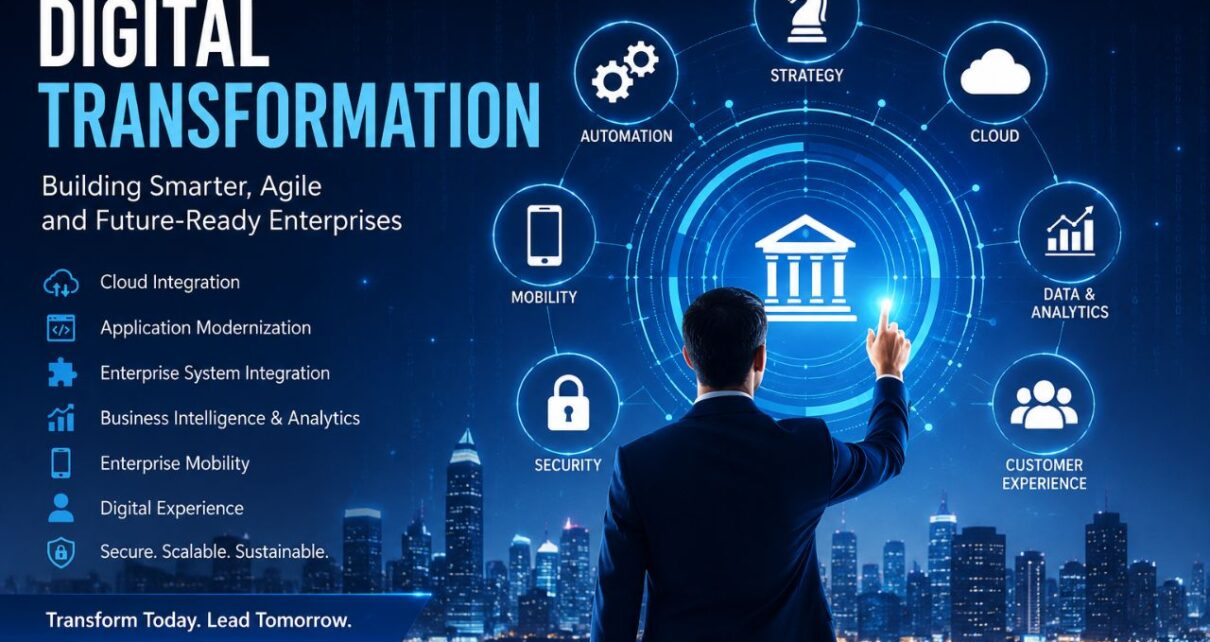
For enterprises, transformation can involve several areas, including application modernization, cloud adoption, business intelligence, automation, system integration, artificial intelligence, enterprise mobility, and digital experience development.
The exact approach depends on the organization’s goals and industry.
A retail company may want to create a seamless omnichannel shopping experience. A manufacturing organization may focus on automation and predictive maintenance. A financial institution may prioritize mobile banking, cybersecurity, fraud prevention, analytics, and personalized services.
The objective should always be to connect technology investments with genuine business requirements.
Why Enterprises Need Modern Technology
Customer expectations are changing quickly. People are accustomed to mobile applications, online payments, instant communication, self-service platforms, and personalized digital experiences.
They expect businesses to deliver consistent services whether they interact through a website, mobile application, social platform, physical location, or customer support channel.
Employees also require modern technology. Remote and hybrid work environments have increased the need for secure access to applications and information from different locations.
Data is another important factor. Enterprises generate enormous amounts of information through transactions, applications, websites, connected devices, customer interactions, and internal operations.
When information is stored in disconnected systems, businesses may struggle to obtain a complete view of customers, processes, and performance.
Modernization can help connect these environments and make information more useful.
Assessing the Existing Technology Landscape
Before beginning a transformation initiative, an organization should understand its current technology environment.
A technology assessment can examine:
- Legacy applications
- Cloud and on-premises infrastructure
- Databases
- APIs and integrations
- Business workflows
- Security controls
- Customer-facing platforms
- Data management practices
- Application dependencies
This assessment can identify technical debt and opportunities for improvement.
For example, an enterprise may discover that its sales and customer service teams use separate customer databases. Employees may have to manually transfer information between systems, increasing the possibility of errors.
Integrating these systems could improve information visibility and reduce repetitive data entry.
Another organization might rely on an application that requires several manual steps to complete routine tasks. Modernizing the application could improve productivity and reduce processing time.
Understanding dependencies is equally important. Changing one platform may affect other applications, databases, integrations, and business processes.
Creating a Transformation Roadmap
After assessing the current environment, organizations can define their desired future state.
A transformation roadmap should connect technology projects with measurable business objectives.
Instead of simply deciding to “upgrade technology,” enterprises can define specific goals such as:
- Improving customer satisfaction
- Reducing operating costs
- Increasing digital adoption
- Automating repetitive processes
- Improving employee productivity
- Strengthening cybersecurity
- Reducing application downtime
- Accelerating product development
Projects can then be prioritized according to business value, complexity, investment requirements, risk, and organizational readiness.
A phased approach can be useful for large enterprises. Organizations can begin with high-priority initiatives, measure their outcomes, and use those lessons when planning future projects.
Transformation roadmaps should remain flexible because market conditions, customer expectations, regulations, and technologies can change.
Cloud Computing and Enterprise Scalability
Cloud computing has become an important part of modern enterprise architecture. Cloud environments can provide scalable resources, flexible infrastructure, and access to various technology services.
However, cloud migration should be carefully planned.
Organizations need to evaluate security, compliance, performance, application dependencies, data management, availability, and operating costs.
Not every application needs to move to the cloud immediately. Some workloads may be suitable for direct migration, while others may require redesign or modernization first.
Some applications may also remain on-premises because of regulatory or operational requirements.
For organizations with complex environments, hybrid architectures can provide flexibility.
Cloud integration is equally important. New cloud applications often need to communicate with existing enterprise systems. Effective integration can help organizations modernize gradually without disrupting critical business processes.
Modernizing Legacy Applications
Legacy applications can be difficult to maintain, but they often contain valuable business logic and support important operations.
Replacing them completely may be expensive and disruptive. Application modernization provides different approaches for improving these systems.
Depending on the application’s condition and business importance, an organization may restructure existing code, migrate it to modern infrastructure, redesign selected components, integrate it with newer services, or replace it entirely.
The right approach should consider:
- Business importance
- Maintenance costs
- Security requirements
- Performance
- Scalability
- Technical limitations
- Integration requirements
- Future business needs
Modernization should make applications easier to maintain, secure, integrate, and scale.
Enterprise System Integration
Large organizations commonly use specialized platforms for finance, sales, marketing, human resources, customer service, supply chain, and operations.
When these systems operate independently, information can become fragmented and employees may need to transfer data manually.
Enterprise system integration can connect these platforms and improve the flow of information.
For example, integrating customer relationship management with billing and support platforms can provide employees with a more complete view of customer interactions.
Similarly, connecting sales and inventory systems can improve information accuracy and help organizations respond more effectively to demand.
A scalable integration architecture can also make it easier to introduce new applications without creating additional data silos.
Enterprises Digital Transformation in Banking
The banking sector is experiencing significant technology-driven change. Customers increasingly expect mobile banking, digital payments, online account management, instant notifications, and convenient access to financial services.
Enterprises digital transformation in banking goes far beyond creating a mobile application. Financial institutions need to consider core banking modernization, customer journeys, data management, automation, cybersecurity, analytics, system integration, and compliance.
Digital onboarding can simplify account opening and reduce paperwork. Automated workflows can reduce repetitive administrative work and improve operational efficiency.
Data analytics can help banks understand customer behavior and develop more relevant products and services.
Artificial intelligence can support customer service, fraud monitoring, risk analysis, document processing, and other financial operations.
Security is particularly important because financial institutions manage sensitive personal and financial information. Identity management, encryption, access controls, monitoring, privacy, and regulatory compliance should be integrated into modernization programs.
Successful enterprises digital transformation in banking requires collaboration between technology teams, business leaders, cybersecurity specialists, risk professionals, and compliance departments.
Data and Business Intelligence
Data is one of the most valuable resources available to modern organizations. However, simply collecting information does not guarantee better decisions.
Businesses need effective systems for storing, integrating, governing, and analyzing data.
Business intelligence can help managers monitor performance and identify important trends. Advanced analytics can reveal patterns that may not be visible through conventional reporting.
For example, retailers can analyze purchasing behavior to improve demand forecasting. Manufacturers can examine equipment data to identify potential maintenance issues. Logistics companies can analyze transportation data to improve planning.
Artificial intelligence and machine learning can extend these capabilities by supporting forecasting, recommendations, anomaly detection, classification, and automation.
Data governance should accompany analytics initiatives to ensure information remains accurate, secure, accessible, and responsibly managed.
Improving Customer Experience
Customer experience is an important competitive factor across industries.
Customers may interact with organizations through websites, mobile applications, email, social media, physical locations, and customer support channels.
They expect these interactions to be simple, convenient, and consistent.
Disconnected systems can create friction. Customers may need to repeat information when moving between different channels.
Integrated technology can help create more seamless customer journeys. Authorized customer information can be shared between relevant systems, allowing employees to provide better-informed support.
Personalization can further improve engagement. Organizations can responsibly use customer information to provide relevant recommendations, services, and communications.
The purpose of technology should be to remove friction and create genuine customer value.
Developing a Digital Transformation Strategy
A Digital transformation strategy provides a structured framework for aligning technology initiatives with business goals.
The process can begin with an assessment of existing capabilities and identification of key business challenges. Organizations can then define their desired future state and determine the technology and process improvements required.
A transformation strategy may include:
- Cloud adoption
- Application modernization
- System integration
- Automation
- Data analytics
- Enterprise mobility
- Digital experience
- Cybersecurity
- Data management
Organizations should establish clear performance indicators for major initiatives.
Depending on the project, metrics may include processing time, customer satisfaction, digital adoption, operating costs, employee productivity, application availability, or revenue.
An effective Digital transformation strategy should remain adaptable. Technology and business conditions change continuously, so enterprises should review their roadmap regularly and adjust priorities when necessary.
Automation and Process Optimization
Automation can help organizations reduce repetitive manual work and improve consistency.
Potential opportunities include document processing, data entry, reporting, workflow approvals, notifications, scheduling, and routine customer interactions.
However, enterprises should evaluate processes before automating them. Automating a poorly designed workflow can simply reproduce inefficiency.
Process optimization can remove unnecessary steps before automation is implemented.
When used effectively, automation can allow employees to focus more on analytical, creative, strategic, and customer-oriented activities.
Enterprise Mobility
Modern employees increasingly need secure access to business systems outside traditional office environments.
Enterprise mobility can support sales professionals, field technicians, managers, and remote employees by providing access to relevant applications and information.
For example, a sales representative can review customer information during a meeting, while a field technician can update service records directly from a customer’s location.
Mobile solutions should incorporate authentication, authorization, device management, application security, and data protection.
Enterprise mobility can also improve customer experiences by making services easily accessible through smartphones and tablets.
Cybersecurity and Compliance
As organizations connect more applications, users, devices, and data sources, cybersecurity becomes increasingly important.
Security should be integrated into transformation planning from the beginning.
Organizations can implement identity management, access controls, encryption, monitoring, backups, vulnerability assessments, and incident-response procedures.
Regular security reviews can help enterprises identify new vulnerabilities as their technology environments evolve.
Compliance is equally important for regulated industries. Privacy requirements, data protection rules, industry regulations, and access policies should be incorporated into technology architecture and implementation.
Managing Organizational Change
Technology transformation depends heavily on employee adoption.
Employees may resist new systems if they do not understand why changes are necessary or how the new technology will affect their work.
Change management can support adoption through clear communication, practical training, leadership involvement, and ongoing assistance.
Training should focus on role-specific workflows rather than technical features alone.
Leadership support is also essential. Managers and executives should communicate transformation objectives and demonstrate their commitment to the initiative.
Employee feedback after implementation can help organizations identify usability problems and make continuous improvements.
Measuring Transformation Success
Transformation initiatives should be measured through meaningful business outcomes.
Organizations can monitor metrics such as:
- Customer satisfaction
- Digital adoption
- Processing time
- Operating costs
- Employee productivity
- Application performance
- Service availability
- Error rates
- Revenue growth
Different projects require different measures.
An automation project, for example, may focus on processing time and accuracy, while a customer experience project may measure satisfaction and digital engagement.
Regular measurement helps enterprises determine whether investments are delivering expected results.
Preparing for Continuous Innovation
Technology continues to evolve. Artificial intelligence, cloud computing, automation, analytics, and connected platforms are creating new opportunities for organizations.
Enterprises should therefore view transformation as an ongoing journey rather than a one-time project.
Flexible architecture can make it easier to adopt new technologies as requirements change. Pilot projects can allow organizations to test emerging solutions before investing in large-scale implementation.
Innovation should nevertheless remain focused on business value. Enterprises should evaluate technologies according to usefulness, cost, risk, scalability, and strategic relevance.
Building a Future-Ready Enterprise
A future-ready enterprise needs more than individual digital tools. Applications, infrastructure, data, employees, and customer channels should operate as a connected ecosystem.
NeoSOFT’s Enterprise Digital Transformation services cover areas such as enterprise mobility, system integration, cloud integration, digital experience, enterprise architecture, business intelligence, application modernization, and service-oriented architecture.
These capabilities demonstrate why successful modernization often requires coordinated improvements across multiple layers of an organization’s technology environment.
Organizations can begin by identifying their most important business challenges, assessing existing technology, prioritizing high-value initiatives, and implementing modernization in manageable phases.
Conclusion
Digital transformation is changing how enterprises operate, serve customers, manage information, and respond to market opportunities. Modern technologies can help businesses improve efficiency, connect systems, strengthen customer experiences, and make better use of data.
However, successful transformation requires more than technology investment. Organizations need clear objectives, effective planning, employee involvement, strong cybersecurity, governance, and measurable outcomes.
A well-planned strategy can coordinate improvements across applications, cloud infrastructure, data, business processes, and customer channels. Banking demonstrates how modernization can combine digital convenience with security, compliance, reliability, and customer trust.
Ultimately, future-ready enterprises will treat technology as an evolving business capability. By combining application modernization, cloud integration, automation, analytics, enterprise mobility, and continuous improvement, organizations can create flexible technology foundations that support sustainable growth.
The key is to focus on business outcomes rather than technology for its own sake. When modernization initiatives address genuine business requirements, enterprises can build technology ecosystems that are scalable, secure, resilient, and prepared for future opportunities.