
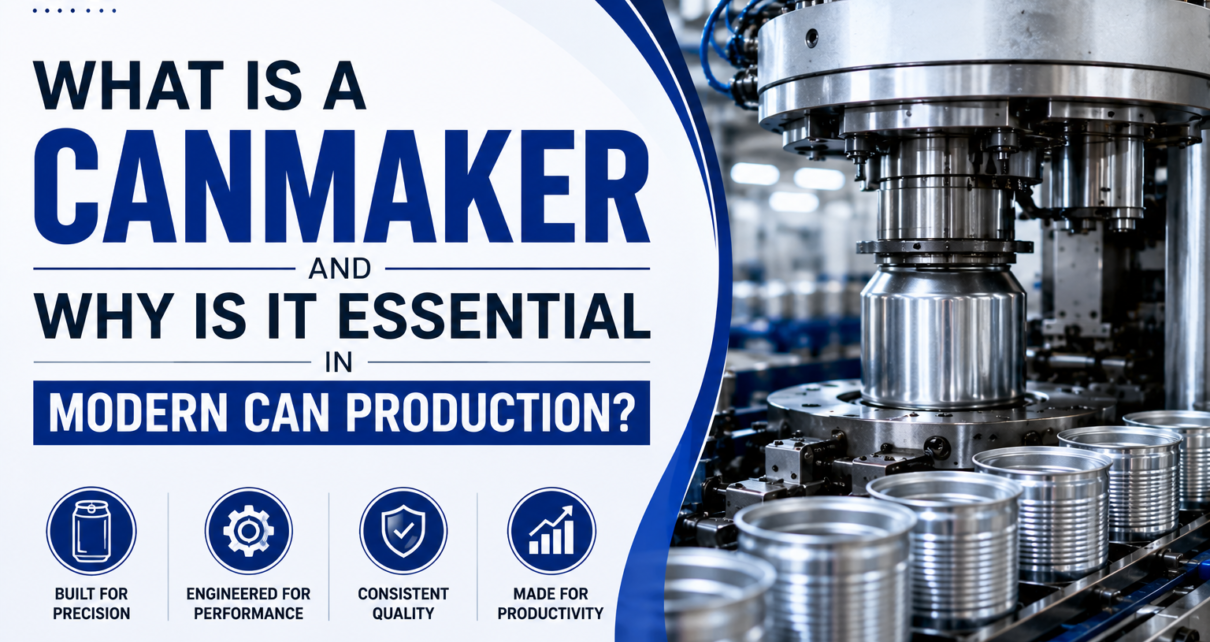
The global demand for metal packaging continues to grow across the beverage, food, aerosol, and industrial sectors. Behind every finished can is a highly engineered manufacturing process that relies on specialized canmaker machinery to ensure consistency, precision, and production efficiency.
One of the most important pieces of equipment in this process is the canmaker. As production lines become faster and more sophisticated, canmakers play a critical role in shaping metal containers that meet modern packaging standards.
Understanding the Canmaker Process
A canmaker is a machine designed to transform metal cups into finished can bodies through a series of forming operations. It is a key component within two-piece can manufacturing lines commonly used for beverage and food packaging.
The machine works by drawing and ironing metal material to create lightweight yet durable can bodies. This process enables manufacturers to produce large volumes of cans while maintaining consistent dimensions and structural integrity.
Modern canmakers are engineered to operate at high speeds while maintaining the accuracy required for downstream manufacturing processes.
The Evolution of Can Manufacturing Technology
Can manufacturing has undergone significant advancements over the years. Earlier production systems required greater manual intervention, while today’s facilities rely on automated machinery and digital monitoring technologies.
Modern production facilities integrate:
- Automated manufacturing systems
- Real-time quality monitoring
- Precision tooling
- High-speed production equipment
- Advanced inspection technologies
These innovations help manufacturers maintain consistent output while meeting increasing market demands for metal packaging solutions.
Where Canmaker Fit Into the Production Line
The canmaking process consists of several stages, including:
Cup Formation
The process begins with creating metal cups from aluminum or steel sheets.
Body Forming
The canmaker transforms these cups into cylindrical can bodies through drawing and ironing operations.
Trimming and Finishing in Canmaker
After forming, cans move through trimming, cleaning, decorating, and necking stages before final assembly.
Each stage depends on dimensional consistency and precise manufacturing practices to ensure the finished product meets industry requirements.
Why Precision Matters in Can Production
Packaging manufacturers operate in highly competitive environments where production accuracy is essential. Even small variations in can dimensions can significantly affect downstream operations, transportation efficiency, and overall product appearance. As a result, manufacturers must maintain strict precision standards throughout the production process. Additionally, consistent can dimensions help improve operational reliability and reduce manufacturing errors. Furthermore, accurate production processes support better packaging performance and product consistency across large-scale manufacturing lines.
Modern canmakers are designed to support:
- Consistent can dimensions
- High-volume production
- Reduced manufacturing interruptions
- Reliable product quality
- Efficient material utilization
As packaging standards continue to evolve, precision engineering remains central to successful can production.
The Role of Industry Expertise
Beyond machinery itself, industry expertise plays a significant role in advancing can manufacturing technology. Companies specializing in canmaking equipment continue to develop solutions that address the challenges of modern production environments.
Organizations such as CMBE have contributed to the development of canmaking machinery, tooling, and production technologies that support beverage, food, and aerosol can manufacturers worldwide. The company provides canmakers, bodymakers, trimmers, neckers, and other canmaking solutions for global manufacturing operations.
Future Trends in Canmaking
The future of can manufacturing is expected to be shaped by automation, digital monitoring, predictive maintenance, and sustainability initiatives.
Manufacturers are increasingly focusing on:
- Smart factory integration
- Data-driven production monitoring
- Improved production efficiency
- Sustainable manufacturing practices
- Advanced machine reliability
These developments will continue to influence how canmakers are designed and utilized across modern packaging facilities.
Conclusion
A canmaker remains one of the most important machines in modern can production. Its role in shaping metal containers with speed and precision makes it a fundamental part of today’s packaging industry.
As technology continues to advance, canmakers will remain at the center of efficient, high-quality manufacturing operations, helping producers meet growing demand for metal packaging solutions across global markets.
Visit: Postmyblogs for more.