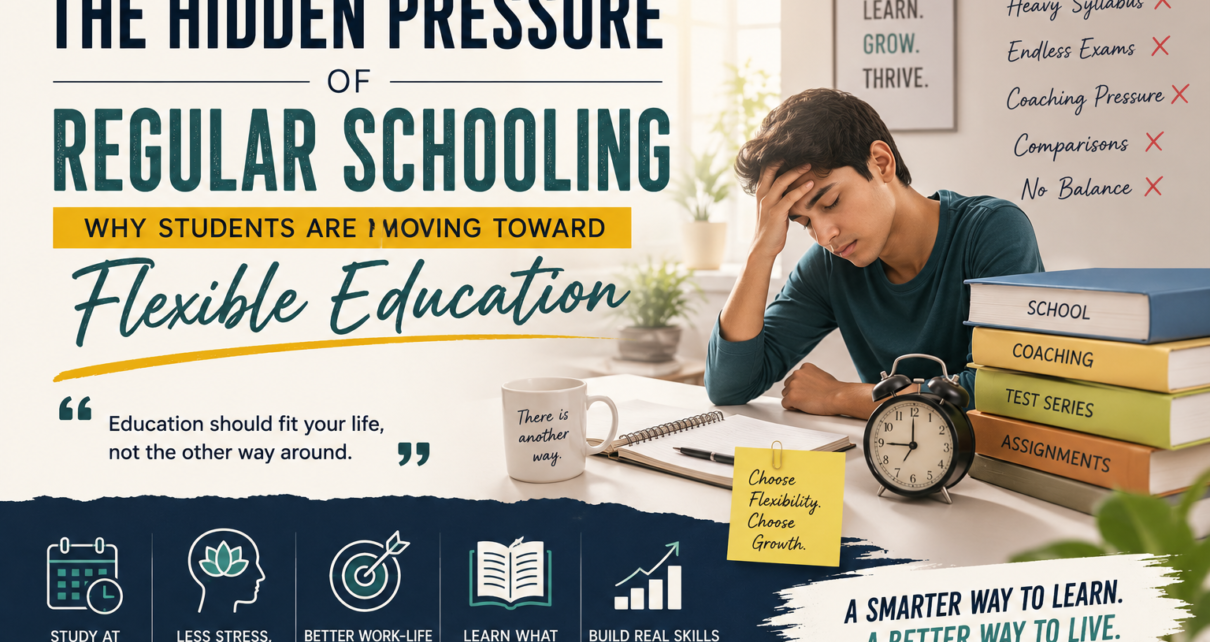
Every morning, millions of students wake up already tired.
Not physically.
Mentally.
They rush through unfinished assignments, attend school for hours, travel to coaching classes afterward, return home exhausted and still sit with books late into the night because somewhere in their mind there’s a constant fear that they are “falling behind.”
From the outside, it looks normal.
Parents call it discipline.
Schools call it routine.
Society calls it hard work.
But many students quietly call it survival.
This is the part of education people rarely talk about honestly. The emotional exhaustion. The pressure to constantly perform. The fear of disappointing everyone. The guilt students feel whenever they rest for even a few hours.
And perhaps this is why more students today are exploring alternatives like the nios secondary course, where education becomes less about constantly rushing and more about actually learning at a sustainable pace.
The shift toward flexible education is not happening because students suddenly became lazy.
It is happening because many students are mentally overwhelmed.
Students Are Carrying More Pressure Than Ever Before
Modern students are expected to manage everything perfectly at the same time.
School exams.
Coaching tests.
Competitive preparation.
Homework.
Attendance pressure.
Career planning.
Social comparison.
Family expectations.
And all of this begins at an age when most students are still emotionally figuring themselves out.
The result is predictable.
Many students stop enjoying learning completely.
They study because they are scared, not because they are curious anymore.
That emotional shift matters more than people realize.
When education becomes entirely fear-driven, students slowly disconnect from confidence, creativity and mental stability. They start measuring self-worth through marks alone.
One bad result suddenly feels like a personal failure instead of a temporary academic setback.
The Schedule Looks Productive. The Student Often Isn’t
One of the biggest misunderstandings in Indian education is assuming busyness equals progress.
A student can spend 14 hours daily “studying” and still feel mentally stuck.
Because exhaustion affects concentration.
Students who move constantly between school, coaching, assignments and tests often experience something dangerous:
Mental saturation.
Their brain stops absorbing information efficiently. They reread chapters without understanding properly. Memory retention weakens. Motivation drops. But instead of recognizing burnout, society simply tells them to “work harder.”
This becomes especially difficult for students preparing for engineering or medical entrances while also trying to maintain school performance.
Eventually, students are no longer learning.
They are just trying to keep up.
And that pressure quietly damages confidence over time.
Many Students Feel Guilty for Being Tired
This is one of the least discussed realities in education.
Students today feel guilty for resting.
If they take a break, they think someone else is studying more.
If they sleep early, they feel irresponsible.
If they score low once, they immediately fear future failure.
That constant mental pressure slowly creates anxiety around education itself.
Some students stop sleeping properly.
Some lose emotional stability before exams.
Some begin overthinking every small academic mistake.
Others continue functioning normally outside while silently struggling internally.
The dangerous part is that many high-performing students hide stress extremely well. Parents and teachers often notice the breakdown only when performance suddenly crashes.
By then, the student has usually been emotionally overwhelmed for months.
Flexible Education Is Becoming a Practical Need
A few years ago, alternative learning systems were often misunderstood.
Today, the conversation is changing.
Students are beginning to ask important questions:
“Can I learn better with flexibility?”
“Can I prepare for exams without destroying my mental health?”
“Can education fit my real life situation?”
And honestly, these are intelligent questions.
Not every student thrives inside rigid academic structures. Some need more self-study time. Some are balancing work responsibilities. Some are recovering emotionally after failure or burnout. Some are preparing seriously for competitive exams and need schedule control.
This is why interest around nios tuition and flexible academic systems has grown steadily in recent years.
Students are no longer looking only for classrooms.
They are looking for breathing space.
The Pressure Is Different for Every Student
People often treat all students the same academically.
But their realities are completely different.
One student may be handling family financial stress.
Another may be dealing with anxiety.
One may be preparing for NEET while managing school attendance.
Another may be working part-time alongside studies.
Some students simply learn slower and need a different pace to understand concepts properly.
Yet traditional schooling often expects everyone to move together at the exact same speed.
Students who cannot keep up start feeling “weak” even when the system itself may simply not fit their situation properly.
This emotional mismatch is one reason students are gradually moving toward flexible learning structures that allow more personalized study routines.
Education Has Changed Beyond Physical Classrooms
The idea that learning only happens inside school buildings no longer reflects reality.
Today’s students learn through:
- Recorded lectures
- Digital platforms
- Online mentorship
- Mock analysis tools
- Self-paced study apps
- Interactive doubt sessions
Technology has changed education permanently.
Students can now access high-quality learning from multiple sources without depending entirely on rigid schedules. This shift naturally increased interest in nios coaching online systems because flexibility has become far more practical and effective than it once was.
Especially for students dealing with pressure or anxiety, studying from calmer environments often improves concentration dramatically.
And honestly, learning works better when students are mentally stable enough to absorb information properly.
The Emotional Cost of Constant Comparison
Modern students are growing up in an environment where comparison never stops.
Marks are compared.
Colleges are compared.
Ranks are compared.
Even study hours become social competition now.
Students constantly see toppers, achievers and success stories online while quietly struggling with their own fears internally. This creates invisible emotional pressure that many adults underestimate.
A student who already doubts themselves begins feeling even smaller.
And eventually, education stops feeling personal.
It becomes performative.
Students begin studying more for validation than growth.
That is emotionally exhausting.
Flexible education systems often help reduce this constant comparison cycle because students can focus more on individual progress instead of daily academic competition.
Students Need Recovery Time Too
One thing regular schooling rarely allows is emotional recovery.
Students move from one test to another without pause.
Low marks in one exam immediately create fear for the next one. There is rarely enough time for students to mentally process disappointment properly before pressure returns again.
This creates long-term emotional fatigue.
And unfortunately, many students only realize how exhausted they were after stepping out of extremely rigid systems.
That does not mean discipline is unnecessary.
It means sustainability matters.
Students perform best when they can maintain consistency without constantly feeling emotionally crushed.
And this is one reason systems like the nios senior secondary course are becoming increasingly relevant for students seeking balance alongside education.
Flexibility Does Not Mean Lack of Ambition
This misconception needs to end.
Students choosing flexible education are not necessarily avoiding hard work.
Many are actually making strategic decisions to protect focus, mental stability and long-term performance.
JEE and NEET aspirants often need more self-study time.
Working students need schedule adaptability.
Students recovering after academic failure need emotional breathing room.
Some students simply perform better in independent learning environments.
Flexibility is not weakness.
For many students, it becomes the reason they finally start learning effectively again.
The Right Environment Changes Academic Performance
Students are deeply affected by their environment.
When they study under constant fear, humiliation, or comparison, performance eventually suffers.
But when students feel psychologically safe, supported and understood, concentration improves naturally.
This is why mentorship matters so much.
A good academic environment focuses on consistency, guidance and clarity instead of constant pressure.
And increasingly, students searching for balanced learning support are exploring nios coaching classes that provide structure without overwhelming emotional stress.
Because students do not only need syllabus completion.
They need sustainability.
Parents Are Slowly Understanding This Too
Interestingly, mindset shifts are happening among parents as well.
Many families are beginning to notice how emotionally drained students become under extremely rigid academic schedules. Parents are seeing burnout, anxiety, sleep problems and loss of confidence more openly now.
As a result, practical thinking is slowly replacing social pressure in many households.
Families are beginning to ask:
“What actually helps the student learn better?”
That question matters more than outdated assumptions about “traditional success paths.”
Because every student is different.
And education should reflect that reality.
The Real Benefits Go Beyond Academics
When people discuss NIOS board benefits, they often focus only on flexibility.
But the deeper benefits are emotional.
Students regain control over time.
They rebuild confidence.
They study with less panic.
They reconnect with learning itself.
And perhaps most importantly, they stop feeling trapped inside systems that no longer support their wellbeing properly.
This emotional stability often improves academic performance too.
Because mentally stable students usually learn better than emotionally exhausted students.
Also Read: Education That Understands Different Paths, Not Just One
A Different Educational Path Can Still Lead to Success
There is a dangerous belief many students carry:
“If my path looks different, my future is ruined.”
That belief is false.
Students completing nios class 12 continue moving toward higher education, entrance exams, professional careers, entrepreneurship, creative industries and skill-based opportunities depending on their goals and consistency.
Success rarely follows one fixed route anymore.
Modern careers value adaptability, skills, discipline and resilience far more than rigid academic timelines alone.
And honestly, students deserve educational systems that help them grow instead of emotionally draining them completely.
Why Students Are Looking for Smarter Support Systems
Students today are not rejecting education.
They are rejecting unnecessary emotional overload.
They still want guidance.
They still want discipline.
They still want meaningful careers.
But they want learning systems that feel sustainable for real life.
That is why platforms like NIOS CLASS are becoming part of conversations among students looking for flexible academic support without constant pressure. Whether someone is balancing work responsibilities, preparing for competitive exams, recovering after burnout, or exploring different nios courses, the goal is often the same – continuing education without losing mental stability in the process.
And for students seeking structured flexibility with proper mentorship, choosing the right nios coaching institute and supportive nios coaching centre can create a much healthier academic experience than they imagined possible.
Sometimes students do not need more pressure.
Sometimes they simply need an environment where they can breathe and still keep moving forward.