
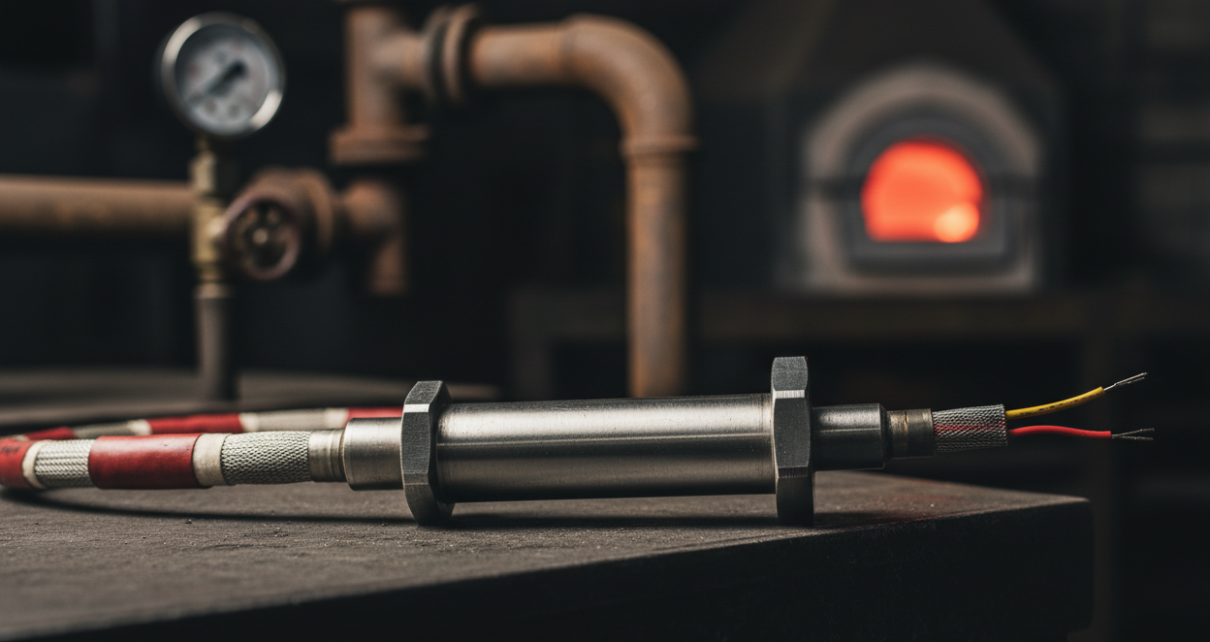
If you think about it, it’s very interesting to wonder about the industrial furnaces. Despite dealing with high temperatures, it never melts down. The Same goes for life-saving vaccines; they manage to maintain their temperature by being cold without getting spoiled, even if they are being transported across the world.
It is all about temperature sensors. These small, wonderful devices are able to sense the variations in heat energy and convert them into visible signals for monitoring systems. Without them, industries would practically be operating blind.
Let’s begin our journey of understanding the working dynamics of temperature sensors and the industries they cover.
Core Sensor Technologies: The Big Four
You wouldn’t use a sledgehammer to crack a macadamia nut. The exact same rule applies to thermal monitoring!
- Thermocouples: These devices work by connecting two different metals with wires. When the temperature changes, the metals create electricity. These sensors conduct hard work in industries without slowing down. Temperature surges close to 4,200°F? About 2315°C? Not a problem at all. The Seebeck effect moves them silently and reliably. The furnaces roar and the conditions make most tools work harder, but they keep reading.
- RTDs (Resistance Temperature Detectors): These sensors use metals like platinum to determine temperature by measuring how much resistance changes over time. They start with a wire coil or film. Their constancy really stands out when accuracy is most important, especially after years of use. They are easy to make, and their results don’t change much over time, which makes them perfect for situations where data must be trusted.
- Thermistors: These are strange little objects that don’t work like the others. They are made of semiconductors and exist in two types: NTC and PTC. Both types are very sensitive to changes in temperature. But here’s the catch: they stop being accurate outside of small temperature ranges. So exact, but so small.
- Infrared (IR) Sensors: Think about having to check something that is too hot or moving too fast to touch. These sensors pick up heat signals that things around us give off that we can’t see. They don’t touch anything; instead, they gather up energy waves from warm surfaces.
- Integrated Circuit (IC) / Digital Sensors: These sensors have a small piece of silicon inside them that turns heat measurements into numbers right away. They fit in tight spaces without needing any extra pieces. They work well with digital systems because they were made for automated plants.
Making Sense of the Data
But here’s the catch: raw data is completely useless if you don’t act on it. That’s where temperature controllers step up to the plate. They take the sensor’s reading and actually throttle the heating or cooling elements to keep things balanced. Sure, arguing over analogue v/s digital temperature controllers is a debate you might still hear in some old-school workshops. Yet, let’s be real, digital is king now. Digital controllers give you pinpoint accuracy, seamless data logging, and easy hookups to modern PLC systems.
Where Are They Used?
You’ll find these devices tucked away in almost every major industry:
- Chemical & Power Generation: Out in the world of chemicals and power plants, where steam roars through pipes and furnaces run nonstop, tough sensors hold their ground.
- Pharmaceuticals & Cold-Chain: Medicine needing cold storage moves under tight temperature control. Sensors track the chill every step, while recorders log each moment silently.
- Automotive: Out there on the roads, today’s vehicles carry loads of tiny sensors inside. From tracking how hot brake rotors get – thanks to infrared sensors that never touch metal – to keeping tabs on engine fluid temps, which might dive to minus forty or climb past one thirty Celsius without warning.
- Food & Beverage: RTDs and thermistors guide every step, whether it’s sealing safety into bottled drinks or setting oil at just the right sizzle.
Choosing the Right Gear
Choosing the appropriate sensor really boils down to what equipment you have. You should figure out what the highest temperature you are able to measure is (e.g., thermocouples are used for max/min temperature and thermistors for the low temperature), how precise you need it to be (like in the pharmaceutical industry, where RTDs are used) and also where the device will actually be installed.
Conclusion:
Clear now, after checking everything: temperature sensors make stopping blowouts and costly fixes actually work. Because of them, hours and cash get saved over time. Right now, factories are shifting fast to clever wireless gadgets that send updates straight to online systems while things run. Some might claim what’s coming for machine oversight feels balanced – maybe even bright.
Explore More Topics: Why Every Industrial Setup Needs a Reliable Hydraulic Filtration Machine


